Analytics traffic records 485,524 page-views by 251,483 unique visitors over the 182 days, or 2,667 page-views per day for an increase of +365 page-views a day compared to the previous 6 months.
(Lifetime total: 11,904,007 page-views by 5,165,795 unique visitors.)
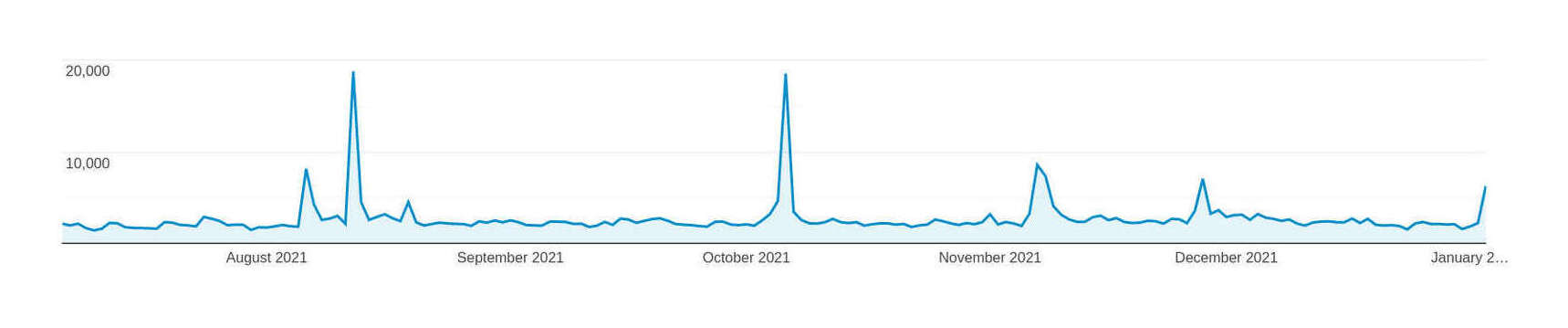
Plot of page-views (y-axis) versus date (x-axis), late 2021
Improvements: 37,467
TWDNE: 22,877
GPT-3: 22,464
Startup ideas: 18,171
Faces: 16,933
About: 15,991
Spaced repetition: 14,155
The Melancholy of Subculture Society: 14,122
Links: 13,582
Danbooru2020: 11,066
With popovers implemented, I turned my attention to revamping the documents directory system into a considerably more powerful tag system. First, I recreated the link-bibliography feature for each page, but at the directory level: directories can now be ‘browsed’, viewed as a long document with each file’s annotation transcluded (or just a bare link if that is all that is available). So one can scroll through all, say, AlphaStar-related documents. With these ‘directory indexes’ available as on-site pages, they can of course be popped up. Now, if there is a directory of documents on a specific topic which can be viewed as a list, and we can automatically link to this list from each member document, what is that? Why, it’s a ‘tag’, of course! So, directories are now considered to define nested tags; tags can be added to annotations of URLs, and so each annotation now defines a virtual file, which will be transcluded into the directory index as if it were a local file inside that directory. (For example, /doc/ai/nn/transformer/gpt/ is now the tag ai/gpt; it contains files such as Radford et al 2019, but it also ‘contains’ a wide variety of URLs or files in other directories whose annotations include the tag ai/gpt.)
This took a fair amount of iteration and fiddling with presentation and tooling, but the result is a fairly powerful tagging system which required next to no frontend JS/CSS changes, while remaining fully static. (This allows much more flexibility in organizing files since they no longer need to be in a single master winner-takes-all category, and it takes a lot of the burden off the pages which were just bibliographies, many of which could be turned into tags instead: instead of manually updating with entries, I can simply add the tag and it will auto-update.) With a ‘tag’ system implemented, I spent a lot of time setting up tags for topics I’ve noticed but have never written a page on (eg. the inverted U-curve of novelty preferences).
Other major features included ‘backlinks’ (reverse citations), and ‘similar links’ (generating neural net embeddings, via the OA GPT-3 API, of all annotations to find similar links, which can be used inline or browsed via yet another link that pops up). In addition, there was endless tweaking of rewrite rules, squashing various bugs, refactoring, writing little helper tools, etc., not worth going into any detail on but all time-consuming. So, not much writing done.
My Patreon profile was flat and down on net at $1,333/month.