What is the “afterglow effect” (1/2, /r/hangovereffect) where some people with ADHD-like symptoms report abrupt temporary relief during the hangover the next morning after consuming large amounts of alcohol & sleeping? (Anything to do with methanol? Or uric acid?)
Why does sleep deprivation briefly treat depression (Boland et al 2017, Daghlas et al 2021)? This makes no sense under the usual theories of depression like chronic inflammation or risk-aversion or too-little brain plasticity, but the experimental effect appears well-established. (And how does ketamine work anyway?)
If child abuse and emotional neglect is so harmful and there is nothing more to it than that, why does it appear in the biographies of so many people who achieve greatness, often middle/upper-class? It may do this by increasing variance (offsetting, for the top end, decreases in mean outcomes), but how—why would any subset of children have better outcomes for any reason because of abuse/neglect? If it increases motivation and creates a ‘rage for mastery’, is there any way to capture the benefits without being evil?
-
What and why and when are “furries”?
One of the core demographics of Patreon, by amount spent, is the “furries” subculture commissioning artwork & other things catering to their fetishes; furries are also well-represented on image boorus, providing some of the largest & best tagged databases (even larger than Danbooru), and historically were (along with fanfiction) one of the most extreme userbases of del.icio.us; further, furry conventions are surprisingly robust, catering, among other things, to fursuit makers selling extremely expensive (and often custom) fursuits; even further, furries appear to be extremely overrepresented among tech workers (an autism spectrum connection?). I’ve kept noticing furries within a few degrees of me (an artist acquaintance does SFW furry commissions, an online acquaintance learned English thanks to furries, another told me of furry IRC channels for just techies coordinating projects & trips & donations, yet another told me that it was not uncommon to see furries suited up in datacenters, the Damore lawsuit materials mention furry groups in Google along with ‘otherkin’, and so on), public examples of furries like SonicFox are increasingly common, and I’ve begun to wonder. In general, furries seem to be bizarrely rich, well-connected, and capable—the Quakers of fetishes. (Does the under-serving of furries foster self-reliance & skill-building—no one is going to make any fursuits or software for them if they don’t—and an early migration to the Internet back when that forced community members to develop considerable technical skills, positioning them for the explosion of the Internet sector?)
Is this true, why are furries so rich and well-funded, and why tech, specifically? Why so many so recently, not just offline, but in their safe spaces online? When did ‘furries’ become a thing? I have yet to run into a clear reference to them before the 1970s–1980s, typically vaguely ascribed to convention dynamics, and they may primarily postdate even that (see WP & WikiFur & 2 Reddit discussions).
But it is not as if anthropomorphization or novels featuring animals or funny artwork of animals were only invented in 1970s or 198046ya; for example, the Playboy bunnies were 1960s, the Batman character Catwoman was 194086ya (just barely preceding Cat People), Disney had centered around anthropomorphization since 192898ya, I Remember Lemuria! was 1940s, Japanese catgirls were 1920s (although one could trace it back to Cordwainer Smith publishing in 1960s, assuming one didn’t tap into the general eroticization of cats which arguably goes back all the way to the Egyptian use of ‘miw’ for cats and then girls, and the fertility cat-goddess Bastet, serving along the way as a symbol of promiscuity, and Egyptian cartoons from thousands of years ago comically depict cats & rats, see Malek’s The Cat in Ancient Egypt) and probably one could trace many examples much further back than 197056ya. So why did it come into existence then, rather than long before, and what has made it so common? Why does it follow the apparent demographic patterns it does?
If it indeed did arise in the 1970s due to some generic combination of economic development, popularity of comic books, technology, or cultural shifts, did many other paraphilias arise in the same time period? Indeed, where do paraphilias in general come from?
Does low trace levels of lithium in drinking water (which would be quite cheap to increase) reduce violence/crime/suicide/mental illness/death, or not?
How concerned should we be about anesthesia awareness (WP)?
How concerned should we be about concussions/head-injuries/“traumatic brain injuries” (TBIs)? Are we crazy for not wearing walking/driving helmets?
Why do I persistently get problems in self-experiments using metals like potassium & magnesium?
What is the psychology of “collecting” and “collectibles”? Particularly from an evolutionary psychology perspective. Can it possibly serve any function, or what continuum is it a maladaptive extreme of?
Did Calhoun’s Mouse Utopia exist as described or replicate? One of the most famous animal experiments ever run, with dramatic political implications, Mouse Utopia turns out to be bizarrely under-documented with many tell-tale signs of the Replication Crisis: Calhoun published little, his publications lacked many details and seem to imply that the famous Mouse Utopia was merely one of many experiments (most of which did not deliver similar results), it did not replicate when others early on attempted it, and there are other possible explanations Calhoun did not have any interest in investigating & simply dismissed out of hand.
How does fetish economics work in general? Anecdotally, creators in fetishes (eg. feet, furry, futanari) report it being highly lucrative despite them not enjoying it themselves—indeed, it’s lucrative because they don’t enjoy it and only do it for the money, requiring extraordinary premiums.
The imbalance is long-standing, and common to many fetishes. An absolute lack of supply is clearly not the reason, and a “risk premium” based on stigma appears inadequate for an imbalance that looks more like excess demand rather than extreme scarcity of supply. I suggest that fetishes do have high demand, as an inherent property of being extreme differences in preferences, and this uses up all fellow-fetish creators and then runs up into very high reservation prices from outsider creators, thereby resulting in unusual prices at the margin.
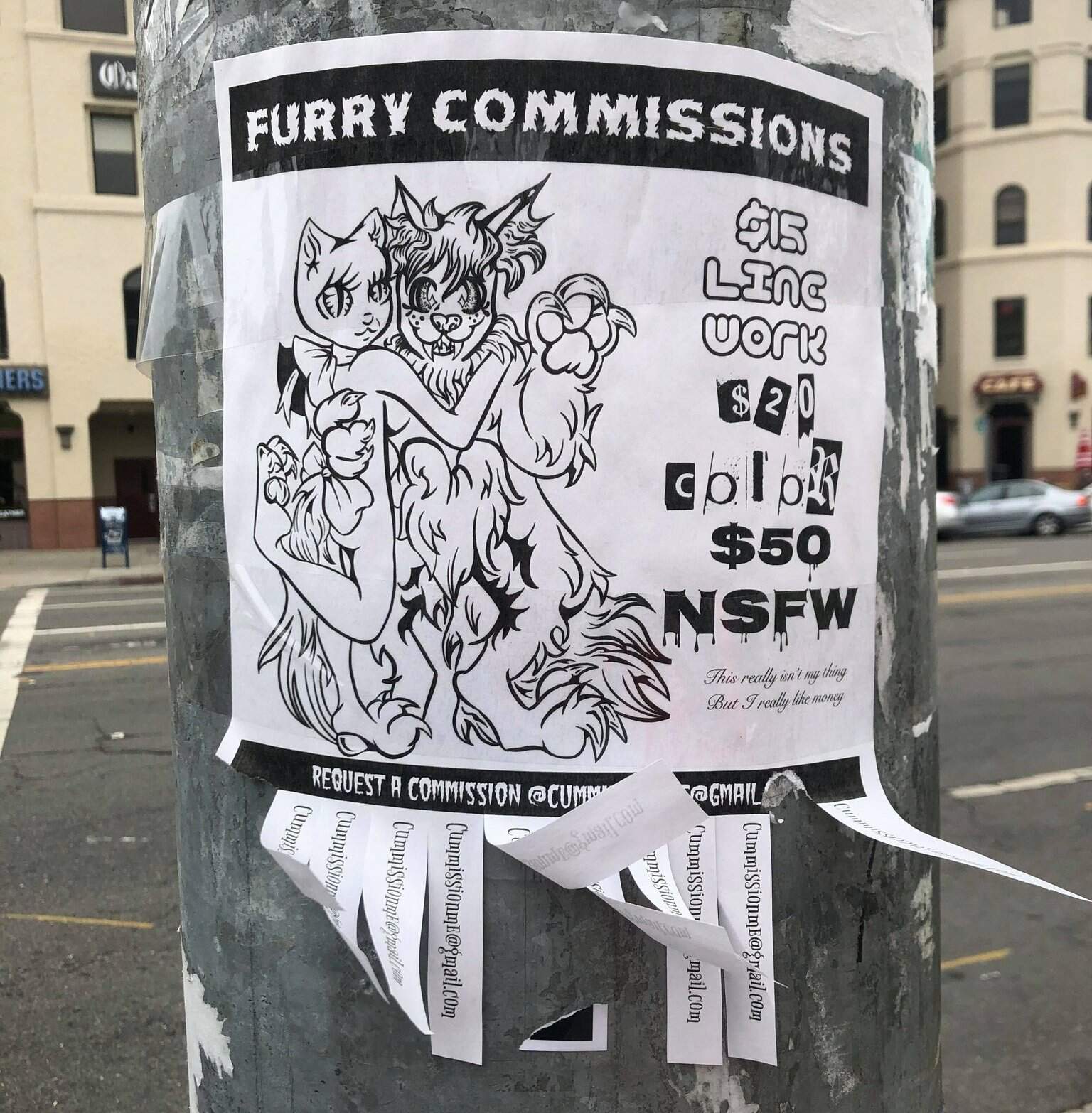
“This really isn’t my thing / But I really like money” (photo by Jennifer Xiao)
Furry art has a reputation for being easy money if you can tolerate the work, and more than one creator has anonymously reported that the commissions revolt them but there’s no way to make thousands of dollars a month as an illustrator as easily; I have heard about at least 2 computer game developers who marvel at the amount of money they can make off foot or other fetish games (often technically trivial, being visual novel-style games using free software like Ren’Py, requiring mostly artwork & writing), easily up to $4,976.88$4,0002021/month. (In one of those cases, they wrote a fic to mock the fetish, but the positive reactions—accompanied by demands of “take my money!”—convinced them to start making & selling actual games.)
These disparities do not seem to be new or reflect trendy topics; there appear to be large increases in commissioned artwork, for example, but driven by innovations in market mechanisms & supply-side factors (eg. the rise of Patreon, or 2-sided commission markets like Skeb.jp—which benefits from the huge progress in machine translation, and easier international payments). The demand was always there, but could not be easily tapped. A related question is BDSM; one is always hearing about female doms (but not subs) making extremely large amounts of money, much more than regular sex workers—it makes sense if there are more female subs than female doms, and vice versa fewer male subs than male doms, but then why the extreme premiums when it seems balanced?
This sort of massive premium is a little odd on the face of it: why is supply & demand so imbalanced, and supply so inelastic? If a fetish is X% of the population, one would expect X% of programmers, artists, etc., to share that fetish. If there are a lot of people who want foot-based games, then one would expect there to be a smaller but still large number of people willing to supply such games, and the problem solves itself; if there are not many fetishists, they may go wanting, but there also won’t be all that much money in catering to them either, it would simply be an odd niche that perhaps some creators happen to occupy, but not strikingly lucrative.
While we don’t know much about why paraphilias change over time or why a paraphilia may develop in the people it develops in, we definitely don’t know any reason to expect a fetish to be underrepresented in artists/programmers and overrepresented elsewhere. There probably are differences (simply on “everything is correlated” grounds), but we don’t know which (in the 3 Fs mentioned, artists/programmers do not seem underrepresented, if anything, perhaps the opposite), nor do we know that they are so large that they could drive these premiums.
A lack of generic supply is also a questionable explanation. “Those lucky vanilla heterosexual types have all the porn in the world and can go their entire lives without spending a cent, but you drew the short end of the stick.” Sure, if there were some dire shortage in absolute terms, like only a dozen pictures across the Internet of your fetish, you may find it worthwhile to pay for more yourself. But this is hard to reconcile with the facts. Can we really say that there is a dire shortage of each fetish when image boorus or porn video sites devoted to each type, like e621, can collect millions of images/videos within a few years? (Danbooru, for example, adds >0.5m images/year—and it has a reputation for being selective!) ≪X%, accumulated over time worldwide, can still be vastly more than any individual can reasonably consume in a lifetime. None of these fetishes seems likely to have a true shortage, per individual, of spank material; if they feel themselves supply-constrained and having difficulty buying more, there must be more going on.
One possibility is that the premium is a risk premium, compensating for participating in a fetish regardless of how much one enjoys it. Perhaps even talented foot fetish artists are reluctant to do more than play footsie with that fandom, because it might get out and handicap them socially or financially? It is difficult to port a reputation in only one direction: if the Z fetishists, who are X% but are frustrated at getting ≪X% of total supply, know an artist offering commissions is mainstream artist Y, and want Y’s services because they can see Y does great work, and Y like that fetish and so doesn’t need to demand a premium due to the greater intrinsic costs, Y may still be worried about “Y does fetish Z” getting out and either demand a big premium or set up under brandnew pseudonym A (if they do at all—any good artist will worry about their art style being identified; ex ungue leonem), constraining output due to lack of reputation.
There is a definite hierarchy of how stigmatized fetishes are, and this seems like a highly plausible hypothesis. Feet aren’t too bad; models in interviews sound kinda nonchalant about it, taking an “it’s weird and I don’t really get it, but it sure pays the rent” perspective. Futanari is definitely weirder, and furries weirder still, having long been the butt of Internet status hierarchies. And it does seem like the supply problem gets more acute as you go down, which is consistent with the risk premium hypothesis. But is this a big enough effect to drive such wacky price dynamics? Are futanari or foot visual novels so discriminated against that all the creators flee and yet, one can pick up thousands of dollars by simply rolling their eyes and ignoring these stigmas with no visible consequence? (And if we believe most creators have fled, where do all those millions of images and videos and games come from? Just how many would there be if all of the creators stayed‽)
If you don’t find that adequate, what else could be going on? Since we are dealing with deviant individuals here (in both senses), we might look for generic distribution effects—in particular, our old friend, tails. (Of distributions.) We might argue a priori about X% parity and proportional representation among each fetish or preference, which is a safe argument, but that doesn’t mean that the total distributions of those fetishes need look anything like each other. It would be bizarre to expect every sexual preference or fetish to be distributed equally, when we already know counterexamples like lesbianism vs male homosexuality, and the mere fact of differing stigmas would be expected to create differences.
Imagine a normal distribution of “willingness to pay for custom porn of Z”. For regular porn, it is a wide distribution centered around the population mean. But when it comes to, say, feet, there may be some willingness to pay among non-fetishists for images that happen to include feet (perhaps as part of some more general pose or scene), but the foot fetishists will be their own distribution with a mean shifted far to the right (and probably much narrower, with a smaller standard deviation)—many are still unwilling or unable to pay, but many will be, and because of tail effects, there will be, counterintuitively, multiplicatively many more.
This is another way of saying that fetishes tend to be intense. Such preferences, arising from whatever source, seem to be fairly discrete. There are not going to be terribly many people who feel lukewarm about a fetish and find it sorta-hot-but-OK-maybe-not-really. This correlates with the stigma: the further away a fetish is, the less everyone else can understand it. The intensity is where the disparity in demand comes from: the fetish may have their fair share X% of artists, but they are an intense minority which demands ≫X%. This demand eats up the X% instantly, and goes hungrily looking for more. And, since the fetish is intense and the remaining supply all tend to feel intensely the other way about the fetish (being all the way in the other distributions many standard deviations away from Z), suddenly, at the margin, the clearing price skyrockets. (As an extreme example, consider guro or crush.) Creating X−2% or X−1% of supply is relatively easy (even, free); creating X% is easy; but creating X+1%, that requires pulling in a lot of creators from elsewhere and that is increasingly and eventually extremely expensive. Personal preferences are rigid and come from mysterious unknown causes, so both supply and demand here are locked in place indefinitely, without the typical long-run effect where high demand elicits permanent supply increases. (There are comparable examples like science funding: for all that scientists complain about lack of funding, they are individually locked into their particular research topic to the extent that the NIH has to increase grants by 40% to pull in novel researchers!) To the extent that risk premium reduces supply, this merely exacerbates the prices.
(This seems consistent with the observation that as regular porn consumers ceased to pay any money for it, the remaining paying customers were fetish ones, and so porn websites began demanding cheap, easy-to-film fetishes like incest roleplay or interracial—all those require is slight changes to a script or mixing up existing actors.)
The tail effect model predicts that this situation will be stable long-term because it is rooted in human psychology. It further predicts that the premium will be due more to the personal level of disgust experienced by outsider artists than to fetish popularity or risk or stigma because the risk premium is confounded: the stigma will predict the premium, but not cause it, because both are caused by the same thing. Exogenously reducing the social stigma (without people changing their gut response) or reducing it in other ways like providing more anonymous ways to work may ease the supply situation a bit, but will not lead to any major changes in the market. (In comparison, improving mechanisms like market websites or assurance contracts, or automating artwork using neural networks, might well have large effects as it lets the demand more efficiently extract supply. Neural networks don’t care.)
Psychedelics famously dissolve personal identity and make you ‘one with everything’. If there are so many drugs which can do that, where are the drugs which do the opposite, strengthening identity and making you one with nothing?
There are a few candidates like MDMA or ketamine/DXM which may do something like that, but not many and not convincingly.
This may show that psychedelics’ effect on identity is less interesting than it looks: it is easier to destroy than to create, and this may be why so many psychedelics can have such similar effects in dissolving but never strengthening identity.
Psychedelics and hallucinogens induce a bewildering range of sometimes extraordinary effects; but if there’s any common trait to trip reports & descriptions across hundreds of different psychedelics, it’s that they tend to ‘weaken boundaries’. One loses one’s ordinary sense of being a discrete, separate person, identifiable & distinguished from other people, and one begins to feel as one with the people nearby, humanity, earth, God(s), universe, the multiverse, or even grander & more ineffable unities.
Anti-psychedelics to make you soberer than sober. So far so good. But after reading enough Erowid trip reports, I began to wonder: if some drugs can weaken identity boundaries, then shouldn’t there be some drugs which strengthen it? (A drug which makes you not drunk on hallucination, but ‘knurd’, soberer than sober, as Terry Pratchett put it.) And if there are many fewer such drugs than psychedelics, perhaps even zero, then why? (We can imagine an ‘inverse’ or ‘anti-Buddhism’—whose scripture is doubtless Ayn Rand—and which preaches the gospel of greed, focusing on strengthening one’s personal identity, cultivating appetites and preferences, and developing agency; so why not imagine an ‘anti-psychedelic’?) If psychedelics like the ones Shulgin reports can have so many oddball effects like ‘make everything sound like it’s at a great distance’ (I vaguely recall one of Shulgin’s reports mentioning), then surely some of them can reverse their usual dissolving effect. Why can’t I feel, with the same absolute certainty that I feel ‘all is one’, that I am a unique snowflake utterly unlike any other human being or organism? Why is there no drug that dehumanizes other humans, turning them into clockwork mechanisms and zombies and sheeple, while I’m the only real person? A drug which refines identity down to feeling separate parts, memes, cells, biomes, selfish-genes, molecules, atoms…
…Or for meeting mitochondrial, not machine, elves. Or, if that doesn’t really make sense (maybe one already conceives of oneself as maximally separate, in the way the integer 1 is already non-identical to the integer 2 and can’t be made ‘more non-identical’), why can’t any ‘unification’ happen internally? Why does the psychedelic experience always seem to be external, in unifying me with things ‘outside my skin’, as it were? Why, on DMT, does one travel to another universe to meet the machine elves, instead of traveling down inside a skin cell to meet the mitochondria elves, or pause for a chat with the jumping transposons on chromosome 13? Why don’t I meet a Parliament of Organs inside, where my kidneys bicker while my liver sighs? Or to take a more cognitive tack, is there a drug which would let me step back and observe the wheels of my mind go around—see the working memory distinct from short-term memory, the long-term memory pulling up & rewriting memories, where the inner monologue comes from, cruder associative cognition acting before slow serial processes binding many regions in a shared computation…? All of these seem logically & psychologically possible, and not even that strange compared to many drug effects or psychiatric conditions.
Anti-psychedelic candidates:
-
Stimulants If we ask what the ‘opposite’ of psychedelics is, most people would suggest stimulants: cocaine, caffeine, nicotine, amphetamines, modafinil, etc.
Are they ‘anti-psychedelics’ in this sense of identity-strengthening? I’ve never taken cocaine, but the others don’t give me the feeling of freezing the way psychedelics give me the feeling of melting. And perhaps more importantly, even if we claim they do, they seem far weaker. Most caffeine, nicotine, or modafinil use comes nowhere near the effect of quite ordinary psychedelic trips; one has to use extraordinary doses, potentially risking lethal overdoses, to start seeing psychedelic-level effects.
Cocaine and amphetamines (and dopaminergic stimulants in general) can cause a degree of psychosis, but it takes a lot of sustained abuse to begin psychedelic-tier effects like seeing ‘the shadow people’ hallucinations under amphetamines. (And even the most extreme hospitalization-level amphetamine psychosis don’t seem to reach the peaks & depths of a single 5-MeO-DMT trip casually will.)
Psychedelics are just really amazingly powerful. If these are the best we can find for ‘anti-psychedelics’, then we still have a puzzle.
-
Dissociatives: Another possibility is more sedative or dissociative drugs like DXM or ketamine.
I am not personally familiar with DXM nor have I read much about it, but I am skeptical that the effects of dissociation match here. Inducing depersonalization & derealization so you feel like you & the world no longer exist is an interesting effect (however unpleasant), but that sounds more identity-annihilating than strengthening. Likewise, to the extent DXM produces frightening schizophrenia-like intrusive thoughts & inner voices which come involuntarily from nowhere, that’s it breaking down your identity, not strengthening it—you should know where they come from and be able to control or at least understand them.
-
MDMA is an interesting candidate.
While I associate it mostly with cuddle-puddle and therapy and loss of ability to perceive threats/danger, which looks like ‘dissolving’ to me, I am told that when people rolling on MDMA introspect about themselves, they sometimes spontaneously develop an Internal Family Systems Model-like internal dialogue with reified parts of their mind, talking to sub-personalities or personifications. If true, MDMA would seem to count as an ‘anti-psychedelic’ at least sometimes, and would be an interesting psychiatric therapy approach. (MAPS has apparently mentioned this possibility.)
Salvia divinorum: mentioned to me as sometimes having experiences of one’s mind dividing into multiple co-occurring parts, and sounding like a candidate.
Few candidates. Overall, while there are some good candidates, there does not appear to be any large pool of well-known drugs which have astonishing anti-psychedelic effects on par with psychedelics. Even if a few like MDMA or Salvia can do it, this is strikingly rare compared to regular psychedelics, where it seems like hundreds of RCs come onto the market each decade.
Breaking, not making. Why this imbalance? The most obvious answer is that “it is easier to destroy than to create”. A lack of boundaries is the default, and identity is constructed with difficulty. Both a theory of mind and a sense of self are great cognitive achievements, and easily undone.
Shattering the network. On a neurological level, simply weakening global connectivity and the intricate coordination between brain regions will reliably produce dissolution. But it is much more difficult to improve the dynamic coordination of brain regions, making the global workspace more efficient and integrated. After a certain level of disconnection (induced by psychedelics or anesthesia) breaking the unified brain down into modules, one is unconscious, affected regions are no longer able to store verbalizable information in long-term memory for later reporting, or the cut-off regions are so autonomous that they become a blind-spot or agnosia (like in split-brain syndrome).
Brains are hard to fix. In this sense, ordinary consciousness is in fact as about unified as is possible. There are no more brain regions which can be usefully integrated, and the existing regions are coordinated as skillfully as possible given one’s particular genetic endowment, environment, and cognitive development. Some stimulants tweaking the brain usefully, or some oddball side effects which create subjective states faking it, is as good as you can expect. It’s hard to improve a generic human brain, like it’s hard to improve every car’s mileage by dumping random chemicals into their gas tanks without even knowing what model or if they are a diesel engine instead.