Because there is no real original in this world but one’s life.
–Anno, Studio Voice October 1996; translated by Numbers-kun
Interviewer: Is it possible that the fates of the characters in the manga (drawn by Sadamoto) will differ from the anime?
Sadamoto: Well, that’s possible. I might have everybody die, for example. Maybe something like, “This is getting difficult to keep up… Okay, next month is the final episode!” -Kaboom! (laugh) Third Impact occurs and it’s over! (laugh)
Interviewer: (laugh) Well, I hope you won’t let that happen…
–translated by Bochan_bird: “The Japanese for this interview can be found on P64 of the Photo File”Eve”. (Interviewed on February 14, 199630ya - before the initial airing of the TV series ended)”
On the unique appearance of the Evangelion Units…
ANNO: There is a monster in Japan called the oni, which has two horns sticking out of its head, and the overall image of the EVA is based on that. I wanted also to have an image that beneath the image of that robot monster is a human. It’s not really a robot, but a giant human, so it’s different from other robot mecha such as those in Gundam.
On Gunbuster’s alternate future – is it dominated by Russia?
ANNO: There’s a Japanese Empire. In the year 200026ya, the U.S. and Japan had a war, and Japan occupied Hawaii. Sorry.
On the decision to have the final episode of Gunbuster in black-and-white…
ANNO: When you have color, you have an extra dimension of information. Color would have gotten in the way of the sense of scale we wanted to portray with the black hole bomb. Also – no one had ever done it before.
On the date 201511ya which figures in both Gunbuster and Evangelion…
ANNO: The date is from an old show I liked as a kid, and it was also the year in which Tetsuwan Atom took place.
…On anime creators who inspired him…
ANNO: Outside of my staff, Mr. Yoshiyuki Tomino. Tomino’s Mobile Suit Gundam and Space Runaway Ideon are my favorite anime besides Yamato. Hayao Miyazaki, with whom I worked on Nausicaa, animating the scene where the God-Soldier fires, was also a mentor to me.
…On how the protagonist of Evangelion reflects Anno himself…
ANNO: Shinji does reflect my character, both in conscious and unconscious part. In the process of making Evangelion, I found out what kind of person I am. I acknowledged that I’m a fool.
On his religious beliefs…
ANNO: I don’t belong to any kind of organized religion, so I guess I could be considered agnostic. Japanese spiritualism holds that there is kami (spirit) in everything, and that’s closer to my own beliefs.
On whether he is a vegetarian like Nadia and Rei …
ANNO: I like tofu. I just don’t want to eat meat or fish. It’s not for religious reasons.
On expressing himself through animation…
ANNO: Animation makes sense to people in the process of their seeing it. So when people get confused by my themes, or cannot get the overall message, the connection is not really going through, because it didn’t satisfy that person. So there would be less meaning for that individual. There has to be a relationship that comes into being between the person watching and what the character’s saying in the animation itself.
…On Evangelion’s success…
ANNO: As for all the merchandising, it’s just a matter of economics. It’s strange that Evangelion has been a hit. Everyone in it is sick!
On his next project…
ANNO: Another TV show, probably some kind of space adventure.
…On the future of the anime industry…
ANNO: The creators have to change their frame of mind for the field to advance. And it doesn’t look too hopeful in today’s Japan. It’s in a critical condition right now. I don’t think there’s any bright future. That’s because the people who are producing it are not doing well. But there’s also problems in the people who are watching it. The people who make it, and the people who want it, they’re always wanting the same things. They’ve been making only similar things for the past ten years, with no sense of urgency. To get it going once more, you need to force people to go outside, to go out again.
…On his hobbies and interests…
ANNO: My hobby is scuba diving, and besides science fiction, I like to read romance novels written by women. Since I’m a male, I don’t really know the emotions of women. And because I want to understand their feelings, and create more realistic female characters, this is something I have to pursue.
To an American fan who boasted of having spent all his schoolbook money on anime goods…
ANNO: You’re a fool. Study harder. If I could go back in time and tell my college-age self something, I would tell him to study harder, too.
…On getting into the anime industry…
ANNO: If you want to get into anime, my best advice to you as a creator is to please have diverse interests in things besides animation. Look outward, first of all. Most anime makers are basically autistic. They have to try and reach out, and truly communicate with others. I would guess that the greatest thing anime has ever achieved is the fact that we’re holding a dialogue right here and now.
–“Virtual Panel! Meet Hideaki Anno,” Animerica 4:9, p. 27 https://web.archive.org/web/20020606012703/http://masterwork.animemedia.com/Evangelion/anno.html
“This was a one-page transcript of Anno’s remarks at Anime Expo ’96. This is hard to imagine today, but at that point (July 199630ya) the series had been over for two months, yet many American fans still hadn’t seen it–not because they didn’t want to, but because there was as yet no digital distribution of anime, fan or licensed–only by getting a physical copy of the tape could you watch it. This limited the speed at which an audience could grow, of course, and ADV’s version was not yet on the market. Anno said a few things at the AX’96 panel that have been remembered, but what I find most interesting is”when asked about Evangelion’s last two episodes, which upset many fans, Anno cooly replied, ‘I have no problem with them. If there’s a problem, it’s all with you guys. Too bad.’” I’m not absolutely sure (it may be in my transcription notes) but I think Anno might have said “too bad” in English, presumably for emphasis.”
“Pen-Pen was a creation of Sadamoto, to soften the atmosphere. But I tended to forget its existence.”
“I’d say Asuka. She’s cute.”
“Last year I brought back some of your miracle drug, melatonin.”
– Some of Carl Horn’s (TODO: ask him for rest of 3 pages) random notes of things Anno said
This was excerpted from the Neon Genesis Evangelion Book Two:3’s letters page, featuring Q&A with Hiroyuki Yamaga from Fanime Con ’98.
And speaking of letters pages, Book One:3 had a question Widya asked Hideaki Anno at Anime Expo ’96:
WS: Would you consider yourself to be more of the John Lennon or Paul McCartney of Gainax?
HA: I don’t listen to the Beatles, so I don’t know.
There are too many painful things for people to go on living in reality.
Thus, humans run and hide in dreams.
They watch films as entertainment.
…If the director so desires, even malice toward others could be introduced straight into film. I guess that’s one of the attractive things about anime. Changing the tribulation of reality into dreams and conveying that to the people… is that what our work is? For the sake of people who forget reality until the bill comes due, who want to devote themselves to happy fallacies. I guess that’s our job in the entertainment and service sector.
One of the distinctive features of Studio Ghibli’s works is that, even if there are obsessive actions, there are things which appear to have not forfeited their goal. Forfeiting ones goal leads to despair, and is a sickness that can prove fatal. I wonder if Miya-san and his people are familiar with that feeling of despair. Perhaps they don’t want to show that anguish to other people. I think they specifically don’t want to display the negative things called self-loathing and complexes to others. That’s why Studio Ghibli’s works can’t show anything but superficial happiness and a reproduction of reality with all the dirty things omitted. A fiction that imitates reality, and nothing more than a single dream. I suppose that is the governance of entertainment
…When I helped out as an animator for Nausicaa, there’s something that Miya-san often told me. It seems to have come from a Chinese sage, but “There are three conditions for accomplishing something. Those are: Being young, Being poor, and Being unknown.” And, “No matter what, make friends.” So I was taught. This was more than 12 years ago. Yes, I’ve known Miya-san approximately 12 years. In that time, I think Miya-san has achieved various things. However, he also lost many things.
…Postscript. Yesterday, when I was in a state of mental collapse after my latest work had ended [Nadia?], I was moved deep within my heart by an encouraging phone call I received. The words of concern proceeding from the receiver became joy on my end as, with an exultant face, my whole body was buoyed. In secret, I rejoiced in receiving some recognition for myself. Thank you from the bottom of my heart.
–“A Dream World That Hasn’t Forfeited its Goal” –Hideaki Anno, Ghibli ga Ippai Liner Notes; apparently dates to before August 1996
“Evangelion is like a puzzle, you know. Any person can see it and give his/her own answer. In other words, we’re offering viewers to think by themselves, so that each person can imagine his/her own world. We will never offer the answers, even in the theatrical version. As for many Evangelion viewers, they may expect us to provide the ‘all-about Eva’ manuals, but there is no such thing. Don’t expect to get answers by someone. Don’t expect to be catered to all the time. We all have to find our own answers.”
“…Evangelion is my life and I have put everything I know into this work. This is my entire life. My life itself.”
“…For [my generation, after the political failures of the previous], there was nothing to speak of but what was within the ‘magic box’ (television). It’s pathetic, but we had no other options. I think admitting that is a start.”
…[Anno says something to the effect that he (consciously) identifies with Shinji, Asuka, and Misato, but Kaworu and especially Rei belong to his unconscious (Kaworu is his “shadow”).]
Protoculture Addicts #43; Anno, newtype interview: psychology (may be source of claim “Although Hideaki Anno has admitted to being influenced by Jungian psychology, this statement desperately begs a Lacanian reading of the formation of identity.”), ending, interpretation; but maybe it was actually PA63? TODO: when my back-issues finally come in, figure this out
Protoculture Addicts #39; Anno in Newtype interview: satisfactory ending, censorship
However - in Protoculture Addicts issue 42, the editorial speaks of a discussion with a Gainax employee at Anime Expo 199630ya (when Anno attended). It says, “[…] did confirm that the last episodes (from 19 on, but mainly 25-26) were censored following pressure from the PTA (Parent-Teacher Association; but no mention of any legal action) and that they had been botched.”
–https://web.archive.org/web/20080512150745/http://eva.onegeek.org/pipermail/oldeva/2001-August/040229.html; see also https://web.archive.org/web/20111117050807/http://eva.onegeek.org/pipermail/oldeva/2001-November/040705.html
Protoculture Addicts #39 excerpts
According to what he said, making EVANGELION was a very difficult job, as we can imagine. He really looked tired and his words were sometimes too harsh to be reported here.
…“EVANGELION is my life”, Anno says, “and I have put everything I know into this work. This is my entire life. My life itself!” As many fans want to know about the ending of this series, episodes 25 & 26, he says that he is making a different version and those two girls (Misato and Ritsuko) are dead in the end. He says, “I truly believe that sex and violence are part of our human life. These days in Japan, I think Japanese children need to know about those things more… instead of being protected too much from the society. Those matters are a little like a poison: we need to give them to the children little by little to establish an immunity, so they would have the ability and mental strength to resist. A lot of youth I know just don’t have this immunity, and when something terrible happens, they can’t deal with it. In a way, the poison can be the medication at the same time, and I believe that the more we know about those things, the more we can protect ourselves against specific matters.”
Among Japanese fans, Rei is the most popular character from this series, and I asked him why. He says, “Rei-chan is very popular… I think that she’s very quiet and doesn’t wish to talk very much, and doesn’t complain. In Japan, I suppose that girls like that are very much desired. They’re quiet, patient, and don’t complain and work hard. As for Rei-chan, she was created as a pilot for Evangelion… in other words, she is a clone of a human being. When we humans are born, in general, we just show up without having a purpose in our human life! Later, we find a purpose and choose our own way and decide how to live our life. Rei-chan’s case is not like that. She was created solely for the purpose of being an EVA’s pilot and I’m not quite sure if she’s happy.”
…Anno-san says, “Gendo is a type of person who can see and think about the welfare of an organization as a whole. In other words, he’d do anything to succeed. He takes drastic and extreme measures by fair means or foul, or by hook or by crook, in order to accomplish his own purpose. In some ways, he’s mean. He hardly cares about Shinji.”
…I asked him what kind of foods he likes, and he says, “For my daily diet, I eat and love tofu, and I like fish too. I’m not a strict vegetarian but I just don’t like the taste of meat, so I end up eating vegetables.”
…He also says that he has been trying to read romance novels. He says, “I’m kinda shy myself and I don’t know much about the feelings of young women. In order to write something like EVANGELION, to create Misato and other young women, I have to understand more about feelings and their behaviors. Reading romance novels seems to help a lot.”
Basically, he says he practices no religion, but he believes in the human spirit. He’s very much interested in studying Christianity, but personally he feels he hasn’t received much influence from it.
Now, this is Anno-san’s question: “Why has our animation become so popular in foreign countries?”
…To conclude, here is an extract from an interview of Hideaki Anno in the November issue of NEWTYPE magazine (1996-11, pg. 20-23):
I didn’t have any interest in studying human psychology in the past. I only took a course about it at university, but I suppose I always had something in my mind to analyze human psyche. I thought I wasn’t interested in humans very much, but then, when I started talking about myself, I needed words to explain. So, I started reading books on psychology. From Episode #16, EVANGELION’s story went into the direction to ask just what the human mind is all about inside. I wrote about myself. My friend lent me a book on human psychological illness and this gave me a shock, as if I finally found what I needed to say.
Lately, due to the ending of episodes #25 & 26, some people started watching EVANGELION. They were not anime fans. In fact, many of them are females and they tell me that they really enjoyed episode #25, objectively. Most anime fans are furious. I understand their anger. I can’t help laughing when hard-core anime fans say that we did a very lousy job, with intentional negligence. No, we didn’t. No staff members did a lousy job. I feel sad that those fans couldn’t see our efforts. Personally, I think the original TV version we showed ended beautifully.
EVANGELION is like a puzzle, you know. Any person can see it and give his/her own answer. In other words, we’re offering viewers to think by themselves, so that each person can imagine his/her own world. We will never offer the answers, even in the theatrical version. As for many EVANGELION viewers, they may expect us to provide the “all-about EVA” manuals, but there is no such thing. Don’t expect to get answers by someone. Don’t expect to be catered to all the time. We all have to find our own answers.
–Miyako Graham, Protoculture Addicts #43 quoting Anno at AX96, and a Newtype
The design concept in Eva was that the characters themselves should lean towards a relatively subdued appearance. But the plug suits! Gaudy as hell. Embarrassing–I mean, they almost look like, y’know, body paint. Naturally, I thought the cos-players wouldn’t even consider attempting it.
But there were, at the December ’95 Comic Market, the February ’96 Wonder Festival, at the… You know, I hate crowds, so ordinarily the whole cos-play scene is no more than a distant reality. But this… this, I had to see. Specifically, I had to see the girls in sky-blue wigs, wearing white plugsuits. Mmmm. I had to see it.
–Sadamoto, manga vol 2 commentary
[The show had] a ‘live feeling.’ [cf. May/June 199630ya NewType] I [Anno] was creating everything in accordance with the situation at the time….The truth is, the ‘complementation project,’ up until about half-way through the series, I was doing things without having clearly decided [about] the complementation of human beings, [about] what is being complemented.
…I [Anno] really hate the fact that animation - or at least Evangelion, the work I’ve been doing - has become merely a “place of refuge.” Nothing but a place where one escapes from reality - by becoming deeply absorbed in it, [people] simply ran from the pain of reality, and from there was hardly anything that came back to reality. To that extent I feel like [the work] did not arrive [at reality]. Steadily the number of people taking refuge [in the work] increases, and if this keeps up, in the extreme case, it would become a religion. It would become the same [situation as with] the Aum adherents and Shoko Asahara. Perhaps, if I did things correctly, I would have had the potential to become the founder of a new religion, but I hate [that idea]. For clutching at straws [lit. “grasping at a spider’s web”], one person is enough.
–Translated by Numbers-kun; first quote, second quote; from an otherwise untranslated July 199630ya Animage interview with Anno and Yuko Miyamura: https://web.archive.org/web/20080127001226/http://johakyu.net/lib/200719ya/07/2007-07-27-000535.php
The sudden abandonment of the narrative conclusion and puzzles of the fictional world that had been constructed up until the 24th episode, brought about an intense shock in animation fans….
It’s fair to say that Evangelion is a story which depicts “anxiety without a cause” which exhaustively ends with a convincing feeling of tension. It’s clear that this kind of feeling is widespread when we look at the AUM incident and its repercussions. On this point, the work has a striking feeling of the present. However, the thing that we should pay closer attention to is the paradoxical whereby feelings of anxiety are always determined materialistically, but for the people who are caught in the center of this kind of anxiety, they can only experience it abstractly….
One of my friends who is from Poland described his completely accurate impression of Rei as being related to the problems of post-war, in other words Rei is linked to the problems of Bosnia, etc. At the same time I thought that the room overlaps with a science laboratory, particularly a medical laboratory. Therefore, ANNO intersected images of refugees/ trauma with the “scientific” – this is the only word that can accurately express the situation – motif of stark anti-decorativeness. (After all, this would be linked to questions about AUM, more specifically to the problem of “Satyan,” AUM’s scientific laboratories) Rei’s solitude is grounded in a completely tactile substantiality which gives us extremely realistic images of the discommunication that children of the present face. And these images of discommunication belong neither to Kogyal(“child girl”)-like autism nor to otaku-like autism which has been defined in opposition to Kogyal-like autism. (And these two types of autism are nothing more than the opposing gender extremities of post-modern decorativeness)
Motifs such as charming beautiful girls and hi-tech machines which has strengthened the barrenness of anime, and in the end became important elements in his [Hideaki Anno’s] work. It became crucial to articulate 90’s-like problems through stereotypes and abstract motifs. To begin with “Evangelion” is an extremely otaku-like work which was by lots of details referenced from former anime and science fiction films, from the design concept of cockpit to the brand of beer (Here in this aspect I don’t have time to treat it, although it’s important) In other words, it can be said that ANNO broke through the literary imagination of the 1980’s by strongly mixing and re-editting the motifs of the anime-like imagination, which had been completely barren for some ten years….
In the opening scene of “Evangelion” he already inserts a cut of a character which had initially been introduced in the 24th episode. The countless devices of this type means that Anno started the broadcast after conceiving the total structure pretty clearly [indeed?]. Actually, the speed of the narrative development of numerous foreshadowing in the first few episodes indicates that his work was made by reverse calculation of a precise, total construction. The flavor of the episodes of the first half is consistently the same. (Some comical episodes after the 8th episode are considered within this consistency). This story revived the genre of animation and at the same time, clarified the limits of the literary imagination…
According to Anno himself, this change of attitude came about while creating and producing the work. “Evangelion” was received enthusiastically among anime fans. He said that in noticing that autistic, enthusiast reception, he thought he should changed the entire conceptual structure of the work, and in the end that’s what he did. After all of the episodes were broadcast, in what looks like a self-tormenting, auto-destructive critique of anime fans that ANNO would repeat many times in radio interviews, specialty anime magazines, etc., he would clearly reiterate the personal intellectual history of MIYAZAKI and OSHII. All three of them isolated themselves from “anime-like things” owing to their hate of the autism after they achieved overwhelming success among anime fans. But ANNO is completely different from them on two critical points. The first difference occurs in “Evangelion” with its simultaneous deep absorption in the anime-like and it’s distance from it. In Anno’s case the change was terribly compressed. In Miyazaki’s case, the change occurred between the time of the success of “Lupin the Third, The Castle of Cagliostro” (197947ya) and “Totoro,” and in Oshii’s case he took about ten years between the time of the television version of “Urusei Yatsura” and “Mobile Police, Patlabor 2.”
In the second difference, as perhaps an inevitable result of that temporal compression, in ANNO the successful critique of anime was brought about by the logic of acceleration and multiplication, while in the case of MIYAZAKI and OSHII the critique of anime succeeded because of the logic of removal. The last half of “Evangelion” takes the form of a critique of previous anime works through developing all the narrative possibilities and anime-like expressions and pushing them to their limits; in other words producing a totality of the anime-like. Simply put, in the second half of “Evangelion” ANNO produces a super-complicated and super-high speed anime and thereby achieved a qualitative change. Several compositions were made for the purposes of constructing a 90’s savior narrative were rapidly inverted and were instead employed to tear to shreds the interactive communication among the characters. This means that for ANNO, he deliberately cut off communication with anime fans who supposedly can only appreciate works by identifying themselves with and investing their emotions into the characters….
There are no compromises in Anno’s second half. By employing difficult lines and the omission of mise-en-scene , quick scene shifts, and busy cuts with few frames (in animation this is extremely luxurious because it requires a new illustration for speeds less than one frame-per-second) he manages to condense the narrative which would usually have required several episodes into one. For example, Rei dies in the time of just two minutes. We are overwhelmed by its speed. On the other hand simultaneously Anno will one after another invert riddles in the second part of the story that had been solved in the first half. Therefore, if we only watch an episode only one time, the plot will be almost impossible to follow. (In other words this means that ANNO completely disregarded the age of the viewers who would have been expected to be watching at that broadcast time following the rules of the televisual medium. ) Nevertheless, in the last half of “Evangelion” in a dimension completely separate from that of the narrative logic, he was fairly successful at communicating the feeling of anxiety and the misery of the characters who are one after another wounded to the point of death. How did he accomplish that?
The last half of “Evangelion” gradually loses the co-ordination with the complicated foreshadowing that was installed in the first half and loses the science-fictional, simulational reasonableness of the composition of the fictional world. (Which is natural given by the change of direction) However, it doesn’t mean that the structure became careless. Instead a density and strange necessity arises. For example in episode #22 there is the unfolding of an incomprehensible story as Eva brings down the angel on a satellite orbit only by the throw of a special spear. A rational explanation is not even provided inside the story. But certainly the unfolding of the story possesses a certain inevitability with the flow of the scenes. That “inevitability” which exists especially independent from the narrative strategy is the true worth of the last half of “Evangelion.” That inevitability allows for the dissemination of despair and tension….
To put it boldly, from episode 17 until episode 24 (but especially in episode 18, 19, 22, and 23) at the moment when that condensed unfolding reaches its highest point, he several times makes me thing of GODARD. That is not an explanation related to the quality of cinema itself. That doesn’t mean that ANNO tried to cite or parody GODARD. Anybody can borrow stereotypical “Godard-like” images. (Of course ANNO himself does it. For instance using lots of subtitles)
– “Anime or something like it: Neon Genesis Evangelion”, Hiroki Azuma; the quotes from Anno are from an untranslated Hiroki Azuma interview with Anno: https://web.archive.org/web/20080127001231/http://johakyu.net/lib/200719ya/07/2007-07-27-000536.php. Numbers-kun translates part of the interview:
Azuma: Finally, only one question about the “set up” of the work. The enemy called “Angel” has no concrete image. It might be a pyramid, a ring of light, a virus…. in what way did you intend that?
Anno: They were paradoxically presented as things without form. For me the idea of an “enemy” is ambiguous, because my relationship to “society” is ambiguous….. The adults of the previous generation taught us that, despite fighting against the system, they were not able to accomplish anything.
Azuma: I felt it was awfully close to the image of the enemy [presented] by Aum Shinrikyo.
Anno: Aum is part of my generation. I understand them well.
Azuma: Although I’m roughly ten years your junior, from my perspective there seems to be a strong sympathy with Aum from people of your generation. But if you say “an Aum-like thing,” you have to distinguish it from the reality of Aum, right?
Anno: We create works that “rationalize” or “sublimate” our “Aum-like” parts. The people who joined Aum did not do this. Hating society, they cut themselves off by their own volition. I wish Aum itself had “sublimated,” but I think instead it steadily came apart and finally collapsed, ending with this act of self-destruction. Even though there was, to a certain extent, some talent there, overall I had no sympathy for the organization.
Omori: However, [Ryu] Mitsuse-san is more governed by something like an Eastern sense of the transience of things, but the world of Evangelion is more along the lines of Western civilization……
Anno: I dislike Western civilization. I don’t place much trust in Western civilization.
Omori: That is, [you consider it] as something one must repudiate? Not positive -
Anno: No, it’s something like, because I don’t care that much about it, I can make use of it. If I were a Christian believer I couldn’t have inserted Christian elements [into Eva] in that way. I would have been scared to.
Omori: No question. Because you have no attachment to [Christianity], you can make use of the names of the angels without being concerned. Ah, [you can use] these names because the word makes a strong impression, for example. [You can use them] as you think appropriate.
Anno: Even if I received complaints from the perspective of Westerners about the equation of [the terms] ‘apostle’ and ‘angel’, I don’t think it would make any difference [to me?]. Well, there is a single American [see the Michael House interview for his version] in our company, and he scolded me about various things. “You can’t do this.” As I had expected. But I did those things [anyway], I think, without taking any notice of that.
–excerpt from discussion between Hideaki Anno and SF critic/translator Nozomi Omori; translation by Numbers-kun (full original)
The first film will be a feature-length edit of the first 24 episodes, the second, an all-new version of the final two which will provide, according to Anno, “the same ending, but from a different perspective.”
Check the second last color page of the filmbook Vol.9. There it says “the smile of Shinji – who is complemented. And then this is one ending, out of many possible ones”.
…here is the literal translation: [TV Filmbook Vol.9 (Ep26), p.95, seq.19 checkpoint]
“Congratulations” “Congratulations” “Congratulations” Shinji’s friends, acquaintances and parents unanimously congratulate him. Amidst the many words of congratulations, a smile appears at the corners of Shinji’s mouth. A happy/contented smile – that is the figure of the complemented/instrumentalized Shinji. This ending is just one shape, one possibility out of many.
…that particular checkpoint at the bottom of Newtype TV filmbook #9 p25 has a big “maybe” attached. This is not the usual “appears” or “seems”, but instead an explicit “maybe” (ka mo shirenai). The literal translation is:
Misato stretched out her hand to Shinji. At this time she may have intended to offer her body to comfort Shinji. However, this was merely substitutive behavior in order to assuage her own loneliness.
Becoming more and more emotionally intense in later episodes, the clever and intricate design work, otaku in-jokes and bouncey “fan service” expected from Gainax are in EVANGELION interleaved with bizarre, brutal, surrealistic and shocking scenes which caused much controversy and even calls for a boycott against the show. Public outrage over the ambiguous, mocking conclusion of the series - combined with the factor of EVANGELION’s vast popularity - led to the announcement from Gainax that a double-feature EVA “movie” would be released in the spring of 199729ya. The first film will be a feature-length edit of the first 24 episodes, the second, an all-new version of the final two which will provide, according to Anno, “the same ending, but from a different perspective.”
–The Complete Anime Guide: Japanese Animation Film Directory & Resource Guide (second edition) (1997-02-01)
Okamoto (O) said that he watched Evangelion twice though he watched the ending first. He said the reference material he received along with the video has “controversial” written in it. He did not understand at first but later knew why once he watched the whole series.
O - Gunbuster is easier to understand. The final episode in the second video is black-and-white. I think it might be done to make it stand out - I mean the “Okarinasai” at the end.
A (Anno) - My generation was the age when black and white moved to color. I would like people living now to see how great to have color. That was 35 monochrome.
O - I love black and white. Perhaps nearly half of my works are black and white?
A - Recently there are more black and white CM on TV. Poster too. Somehow it is getting popular.
O - And then there is partial coloring.
A - “Part Color”… Everyone is now so familiar with beautiful full color, so on the contrary they see that as unusual.
O - But development cost is high. In the past development solution for black-and-white was always available. Now you need to order it first and then they make the development solution.
A - If it’s color development can be done in the same day. For black and white, they told me to give them 2 days and it became a problem to me schedule-wise. If there is a rush, they would not get it done unless they have 2 days.
O - But that thing does not fade. Print is easy to fade as time passes by.
A - It becomes reddish…
Then some talk about Okamoto’s Nikudan. Anno watched it twice and Okamoto said it’s more than enough…Anno said he still remembered a lot of the scenes and how they are edited and linked.
But the ones he watched most are The longest day of Japan and Battle of Okinawa. He even played it as BGV [background video] when he was doing storyboarding at one time, and then slowly his attention was drawn to the video and ended up spending 3 hours watching it.
Then Okamoto talked about his filming Battle of Okinawa in Okinawa and the problem with lack of manpower and resource, ended up doing one of the characters.
Then Anno said it’s easier in anime – if one more character is needed just draw him. But Anno said anime and real life both have aspects that the other side may envy. For example in anime, the camera does not move, and the shadow and body motion needs to be made realistic. Even with CG it has become easier, it still has that CG feel. Anno then said for anime the main work is still about fixing the motion. Scrolling and wrapping the background is particularly inefficient.
Then more flattery from Anno about how Okamoto’s tempo and scene cutting is suitable for anime. And then Anno talked about frame aspect ratio – love Cinescope and miss its disappearance. Hate standard ratio and also not like Vista. He loves the way when Cinescope aspect is used audience have to follow the scene by moving their heads which is something not possible with TV watching.
Skipped the part that talks about Blood and Sand [血と砂 (No English release - reads “Chi to suna”), 196561ya] and Sengoku yarou [196363ya], and use of long shots. Except that Anno mentioned the fun thing with anime is that the photographer doubles as the actor in anime and in real-life you never see cameraman doubles as actor.
Very technical talk about how many frames of films to use for one blink. Anno said 6-7 frames, if he does not want the scene to get noticed, he put 6, if he wants to make sure it gets noticed he put at least 9 frames. And he said that if it is familiar and static scene, even 2 frames can leave an impression. 3 frames may already make it too slow. But if it is fighting it needs 7-8 frames. Took 12 frames in film, cut may be 5-6, depending on how the pictures look. And of course in dialogue how to cut is already predetermined. He said he spent 12 hours to cut 20 min of animation. The longest time took him 24 hours.
Skipped the part about talking with the audience.
About line of eye sight:
A - In the case of anime, the acting and performance usually does not take that much into account. One reason could be the character design. The eyes of the characters usually stress on the details of the eyes and this make it difficult to put acting by using line of sight. However, in Eva the character design is comparatively easier to do such acting, so I put some effort into that. Like where the character is looking at in that scene, or whether the audience are going to see the eyes or not…
Because it is so fundamental I took great care about it. So unusually I put instructions in the storyboard like “Eyes are looking here”. As I am influenced by director Okamoto, I used camera line of sight more than usual
O - if possible, line of sight should be on somewhere close. And on direction, A would look at B and then speak, and B would look back at A in reaction. It has to be like that…
A - for me, camera line of sight is often on the front. The drawing staff usually hates it. Drawing frontal face is more difficult and often it could not be done well. But if the line of sight goes the other way, it becomes hard to use it to act.
O - There is power if the guy’s sight is close to you
A - yes, that’s it. That has energy in it.
A - I don’t like switching between front and side. It is easier to frame the position of eyes of the characters if it is a front to front exchanges between the lines of sights of two persons. Anime is at the end a 2D thing so the amount of information is limited.
When it is cut to a new scene, the audience will try to search for something to focus, and if it is a face, it will be the eyes they look first. So when the eyes have expressed the information, you can cut to another scene already. In TV anime, static scenes are many.
I think this is the proper way to go. Although I think acting by eyes is very important it is also very tedious. I don’t mind putting effort into doing it but somehow when I look at it later I have a feeling that it won’t get noticed, or nobody cares. And then I get a bit irritated.
O - Perhaps because eyes in anime characters are so big…
A - That has many physical reasons. If we do not make the eyes big and treat it as a symbol for the characters, it will become difficult for many to draw.
O - but one can act just by eyes. Like the position of the iris…
A - true, but as the end we only have the drawings to fall back on. If we overdo that kind of serious acting, it carries a risk of looking ridiculous. Character Design is a difficult thing.
About Director: Skipped the part about old time directors and struggles with studio about rights to edit. Except Anno said that for anime sometimes it needs to do editing without having all drawings. But he thinks editing is fun. Gather extra cuts and then try to experiment by switching the cuts or rearranging order and that is interesting. And even the question of whether to cut 2 frames or not can make a difference.
About Storyboarding: More flattery from Anno about watching Ghost Train and Okamoto said because of AD’s mistake he once needed to take 140-150 cuts in one day.
A - for movies, consensus is impossible
O - Director must be a dictator
A - He is a despot. Nothing can move forward if we have to wait until someone else makes a decision and approves. Also the personal character would not come out. In anime, an overall design called storyboard is made from the very beginning. And the production system is based on that design, so it is easier to unify opinions. On the other hand, there is an image that the director’s job is over once the storyboard is decided.
O - since we are on it, in Gunbuster and Eva last episode, there are parts in black and white, that flashback, that kind of stood out. It used quite a bit of sketch like drawings. Did the storyboard also cover that?
A - It was put in there.
O - Oh, those sketches were interesting. It somehow feels it’s moving.
Anime vs real-life film: Okamoto said real-life is not necessarily better. Anno said many anime directors want to do real-life. Many simply put drawings in place of real-life images and they seem to want to push anime to look closer to real life film. And both think it is not a good idea.
Final comment by Anno - Animation is a kind of static world, but there is a yearn for thrill when it switches from one static world to another static world and that cut to new scene is a most efficient way to get such thrill. And he thinks Okamoto’s style of film cutting has similar effect
A - in a TV anime, 30 min of video has a limit of 3500 pictures. So the images cannot move as much as I want. And how to squeeze out the best from the image in such lack of motion, it is all in the cutting.
–January 199729ya Animage interview/discussion between Anno and film-maker Kihachi Okamoto; Japanese source; translated by Patrick Yip/symbv; “In fact at the end of the article, it was stated the talk took place at the home of Okamoto in Ikuta-ku Kawasaki-shi Kanagawa Prefecture on Wednesday 199630ya Oct 16th.”
Nobi Nobita: “Evangelion reduced me to tears many times. It was truly the first time I cried out and my shoulders shook from weeping due to an anime. The first time it struck me was episode 14. I found the summary part well made too, but, after the commercial ended, there was the point when Rei’s monologue suddenly began. I was like, uwaaaaaa…. crying (laughs). It was like that was the first time it hit me. Up to that point I had thought it was just an entertaining anime, but I felt that this was my own issue.”
–Numbers-kun, June (original scan)
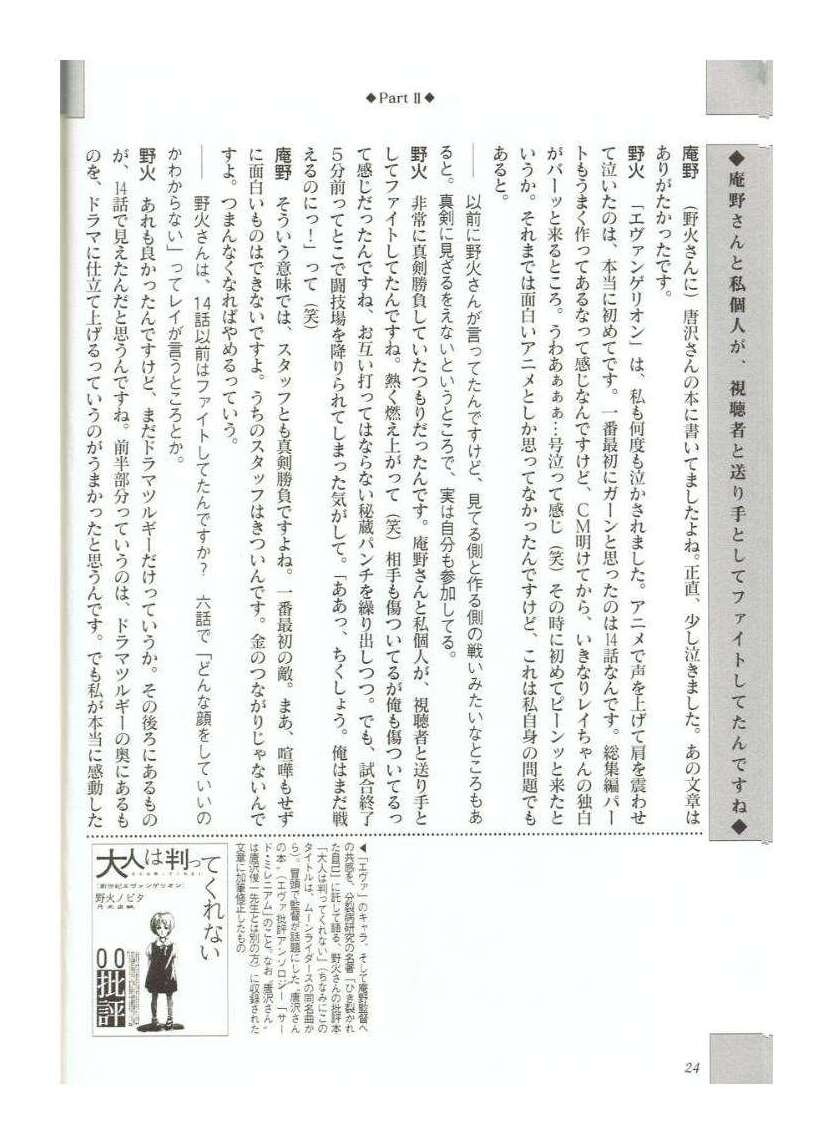
— Nobi-san was reduced to tears by Episode 14. How [did you compose] Rei’s monologue?
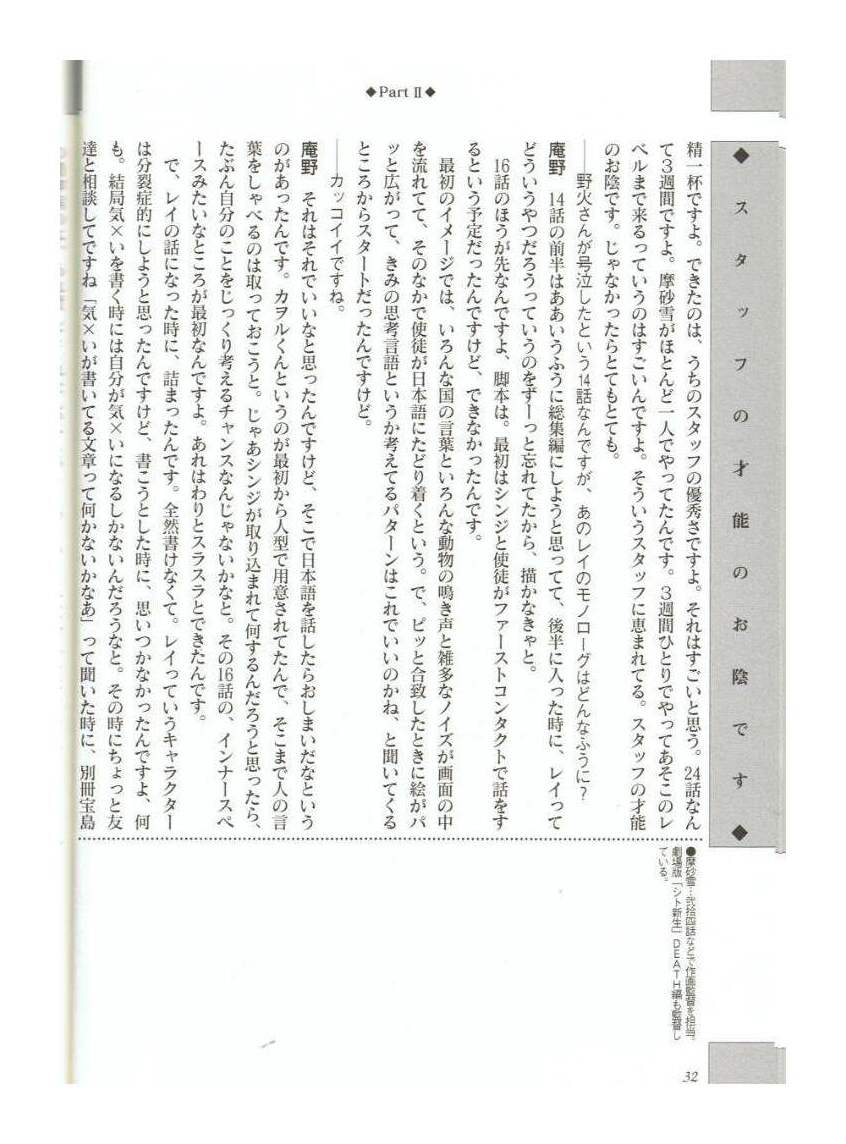
Anno: I had intended to recap the series in the first half of the episode. When I did the second half, I had long forgotten to explore what sort of person Rei was, so [I believed] it was necessary to develop her.
The script for episode 16 had been written before that. At first I had planned [a scenario where] Shinji and the angel would make “first contact,” but I wasn’t able to pull it off.
In the original conception, the languages of various countries and the cries of various animals and miscellaneous noises would appear on the screen; [selecting from] among these, the angel would finally hit upon Japanese. When this happens, there is a sharp noise, an image [suddenly] fills [the screen], and [the angel] asks if this is right for [Shinji’s] thought-language or thought-patterns; it would have started from there.
— That’s really cool.
Anno: As far as that goes, I thought it was fine, but then when [the angel] speaks Japanese that was the end [of my conception]. Kaworu-kun had been prepared as a “human type” [angel] from the start, and I wanted to hold on to the idea of [an angel] conversing in human language until then. When I wondered, well, what will [Shinji] do after he gets taken into the angel, I wondered if this might be [his] chance for self-reflection. Episode 16’s “inner space”-like environment was the first [of that sort]. That went relatively smoothly.
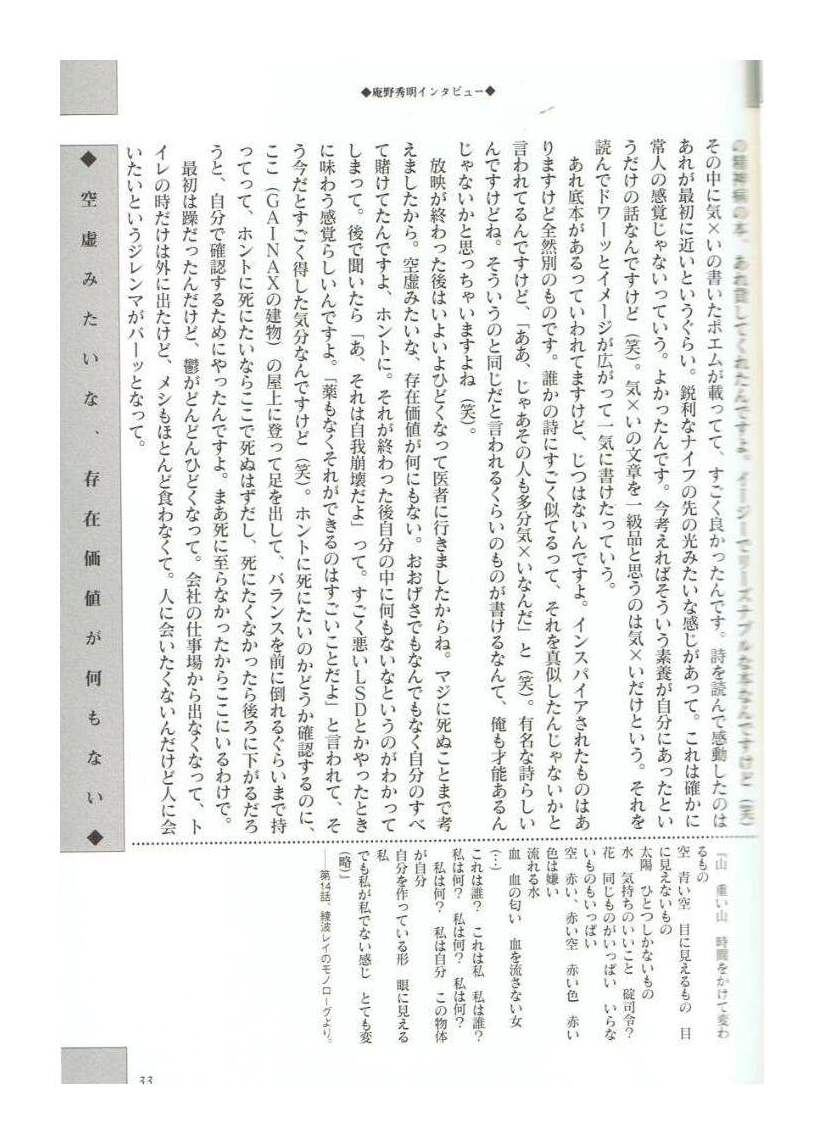
When it came to Rei, I was completely blocked. I couldn’t write anything at all. I had intended to make Rei a schizophrenic (分裂症的) character, but when I tried to write, I couldn’t think of anything - nothing at all. Finally, I thought, when writing madness, one has no choice but to become mad. At that time I consulted a bit with my friends. When I asked if there was something composed by a madman, I was loaned a “Bessatsu Takarajima” volume on mental illness. It was an “easy and reasonable” book [イージーでリーズナブルな本] (laughs), but inside it there was a poem written by a madman. That was extremely good. When I read the poem I had a strong impression, as though this was the first time that I had come close. I had a feeling like a light glinting upon the tip of a sharp knife. It was certainly not the feeling of an ordinary man. That was good. If I think about it now, this sort of ‘capacity’ was [already] within me (laughs). It’s mad to believe that the writings of a madman are of the highest quality. I read that [poem] and was filled with images; I was able to write [Rei’s monologue] in one sitting.
It’s alleged that [the monologue] was based upon another text, but in all honesty, that’s not so. There was something that inspired it, but it was completely different. It’s alleged that it strongly resembles someone’s poem, and it that it was probably copied from it, but, “Ah, well, that man is probably crazy too” (laughs). It seems to be a famous poem. Being able to write something to the extent that it’s said to be the same, I can’t help thinking, “Don’t I have talent, too?” (laughs)
After the television broadcast finished, I became worse and worse, and went to see a doctor. I even seriously contemplated death. It’s like [I] was empty, with no meaning to [my] existence. Without the slightest exaggeration, I had put everything I had [into Evangelion]. Really. After that finished I realized that there was nothing [left] inside of me. When I asked [the doctor?] about it afterwards, [he said?] “Ah, that is an ‘identity crisis’ (self-collapse) [自我崩壊].” It was a sensation as though I had taken something like extremely bad LSD. I was told, “It’s amazing that you were able to do that without medication.” Yeah, now, I feel very fortunate (laughs). In order to determine whether or not I really wanted to die, I went up to the rooftop of this building (the GAINAX building) and stuck my foot out, waiting to lose my balance and fall forward. I did it to personally determine [whether I wanted to live or die], [thinking,] if I really want to die, I should die here, and if I don’t want to die, I’ll step back. Well, it didn’t lead to my death, and so I’m here.
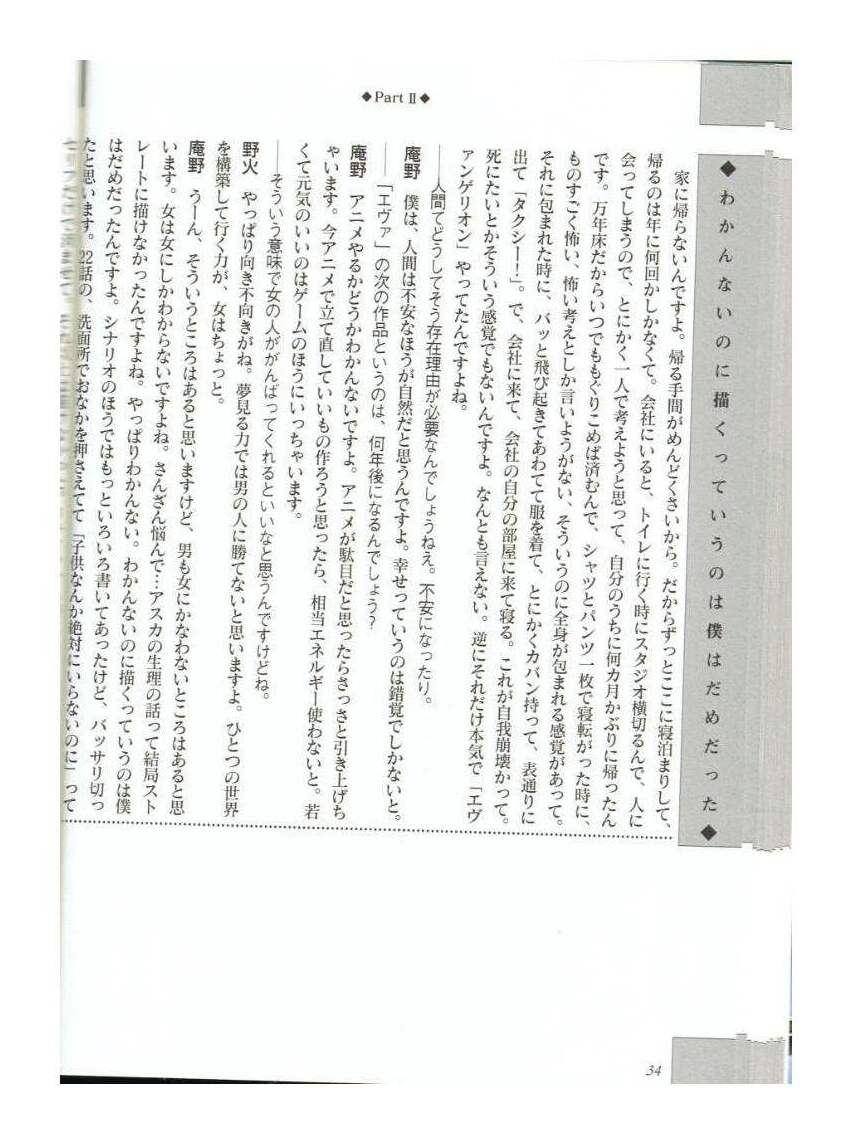
At first I was manic, but I rapidly developed a severe depression. I wouldn’t leave my office at work; I would leave only to use the bathroom, and I would almost never eat meals. A dilemma suddenly arose: I didn’t want to encounter other people, and yet I did want to encounter other people.
I don’t return home [at the end of the day], because the time and effort spent returning is bothersome. I just stay overnight here all the time; I don’t return home more than a few times in a year. At work, when I go to the bathroom, I go across the studio, I have to encounter people. I just wanted to think by myself, so I returned home for the first time in many months. My bed is never made, so there’s nothing to do but crawl into it. When I took my clothes off and lay down - I can’t put it any other way than extraordinarily terrifying, terrifying thoughts [怖い考え] - I had a sensation like my whole body was enveloped in such [thoughts]. When I was enveloped by this, I suddenly leapt to my feet and, in a panicked state, threw on my clothes, grabbed my bag, and went out onto the street, [crying,] “Taxi!” I went back to my workplace, I went back to my office at my workplace and slept. This is the “identity crisis.” I don’t have the feeling that I want to die, or anything like that. There’s nothing I can say [that can explain things]. On the other hand, that was how seriously I took “Evangelion.”
— I wonder why human beings require a meaning to their existence. [The lack of such] produces anxiety.
Anno: I think it’s more natural for human beings to be anxious. I think happiness is nothing but an illusion [錯覚].
–1996-08-22; first interview in June; scans (1 2 3) hosted by Lili & translated by Numbers-kun
[Numbers-kun’s paraphrases follow] This interview contains Nobita Nobi as a special guest. Nobi is a manga/doujinshi author and critic who writes doujinshi, shonen-ai, and criticism under the name Nobita Nobi and writes elsewhere under the name Nariko Enomoto (I assume, but I’m not certain, that this is her real name). She began working on Eva doujinshi during the series.
… 1. Anno’s Love of Shojo Manga
Anno wept a little when he read Nobi’s contribution to Karasawa’s book. Nobi cried many times during Evangelion, beginning with Rei’s monologue in Episode 14. Nobi is asked about her theory that the artists and viewers are locked in battle. She felt that she was in a battle with Anno. Anno thinks his first battle was with his staff. In junior high school, Anno had a friend - nowadays, he says, you would call her a girlfriend - named Ritsuko, who had a major impact on his life and introduced him to sci-fi and shojo manga. Aside from titles like “Devilman” and “Team Astro,” Anno was largely uninterested in shonen manga. However, Anno doesn’t think he would be able to do justice to a shojo manga in an anime adaptation. Anno would read “Bessatsu Margaret,” “Ribon,” “Hana to Yume,” “Betsucomi,” and, at one point, even “Ciao.” Among the authors he likes, he mentions Fusako Kuramochi, Jun Ichikawa, Shinji Wada, Yu Azuki, Mariko Iwadate, Hideko Tachikake, Yukari Takahashi, Yumiko Oshima, and Taeko Watanabe. 2. Devilman and Evangelion
Nobi sees similarities between Devilman and Evangelion. This is due to the fact that Shinji’s mother is ultimately, or ultimately becomes, a kind of angel. As a result Shinji questions his self-identity. In the end, the foundations of human identity are overthrown. Anno says that the similarities to Devilman in this sense were unconscious; he noticed them afterwards. Evangelion follows the pattern of Ultraman and Devilman, in the sense that an enemy is defeated, but the power of that enemy is absorbed. Human beings make a copy of the angels, and then combine it with the human heart or mind. 3. Anno and Miyazaki
Anno was asked to write a commentary for the Studio Ghibli box set; however, in it, he criticized Miyazaki. Anno and Miyazaki are basically at one in their approaches; however, Miyazaki aims for a broad appeal, and Anno does not. Miyazaki risks ending up at “Sazae-san”. In Anno’s view, Miyazaki’s greatest work is volume seven of the Nausicaa manga. If I understood the next part correctly (Anno laughs a lot telling this), when Nausicaa was being serialized in Animage Anno used to visit Miyazaki’s office and ask to see the part of Nausicaa currently in progress; Miyazaki wouldn’t let him, so he would go in and look at them when Miyazaki wasn’t there. Anno wished that Miyazaki would stop making anime and focus on the Nausicaa manga. Miyazaki struggled greatly with how to end the manga; now, Anno completely understands how Miyazaki felt. According to Anno, Evangelion ended up being a cross between Devilman and volume seven of the Nausicaa manga. At an “ideological” level, Anno had to arrive at the same answers. Nobi was deeply moved by the Nausicaa movie when she first saw it, but less impressed after reading volume 7 of the manga. The darkness of the manga is eliminated in the film. However, for Nobi, Anno goes in the opposite direction, and is a kind of “black Miyazaki.” 4. The “Onanii Show”
Anno only makes works for himself, and not for an audience. However, making works is still the only way he can relate to other people. This relationship is like a “masturbation show,” because other people are watching him act to please himself. They decide by themselves how they react to it. He does not directly “pleasure” others. It requires some narcissism to be an author; someone entirely lacking self-confidence wouldn’t “expose” themselves. 5. Anno’s Vegetarianism
Anno’s vegetarianism is the result of the fact that he has no interest in ordinary life, including eating. When he was young his ideal sort of food was what astronauts would take into space. Today he regularly uses “Energy In”. He stopped eating meat at a young age. He wouldn’t eat school meals. When he was in his second year of elementary school, a teacher made him stay behind until he ate his meal. At 8PM the teacher gave up. Anno won’t do things others force him to do. He would rather have died than eat that meal. His parents couldn’t affect him, either. His body is no longer accustomed to eating meat, and now the taste makes him physically sick. He has few “worldly” desires. He has very little desire for food or money. His sexual desire is average. 6. Cel Anime and Expression
The interviewer feels that, behind the desire of women for “June”-like manga and stories, lies the problem of the family, and this is something Eva portrays. However, Anno feels he could not portray human relationships well because of the limitations of the medium, which he discusses. Precisely because of those limitations one must try to remain fixated on “human drama.” 7. The Production of Eva
When Anno thought of Eva, he wanted to create an anime that would surpass “Gundam” and “Yamato.” However, he became dissatisfied with his early ideas. The script for the first episode took half a year to complete. He was stuck after that, so he wrote episodes 5 and 6, and then came back to episode 3. He felt he had to go beyond regular TV anime in developing realistic characters in episodes 3 and 4. However, the first six episodes left the staff drained and feeling weighed down by the heavy mood, so he felt it necessary to lighten the feeling of the series for episodes 7, 8, and 9. This early stage of production took 4 or 5 months in total; the storyboards were done in two months. However, the schedule became more and more constrained. The series was only finished thanks to the supreme efforts and talents of the staff. Episode 26 was completed in only three days. Episode 24 was put together almost entirely by Masayuki alone in the space of three weeks.
Rei’s Monologue / Anno’s Depression
I made attempt at a translation here [Numbers-kun’s translation is quoted previously in this section]. When Anno was working on Rei’s monologue in Episode 14, he wanted to develop her in a “schizophrenic” direction, and wondered how to portray a kind of madness. He was loaned a magazine-like book on mental illness that contained a poem by someone who suffered from a mental disorder, and that triggered his imagination. Anno experienced a kind of nervous breakdown following Eva’s conclusion. He no longer wanted to see people, and climbed up onto the roof of the Gainax building to see if he really wanted to live or to die. In the end he wanted to live, but after making Eva he felt he had nothing left inside of him. 9. Asuka’s Period
Nobi is not sure that female manga writers will be able to match the imagination of the male authors. Anno wanted to do a longer story involving Asuka’s menstruation, but because he felt it was impossible for a man to write, he abandoned it. Only a single scene remained. He feels he can’t match the way Nobi portrayed Asuka in the doujinshi “Absolute Safety Razor” (or “Absolutely Safe Razor” - “Zettai Anzen Kamisori”). 10. Group Mentality
Nobi was irritated by male Rei otaku at Comiket. Anno emphasizes with her irritation. Anno says that Aum demonstrated that some people are driven to be a part of a group. Anno realized how easy it is to become a cult leader. However, the problem is that human beings also cannot live alone and must somehow depend on others. In addition, people nowadays, including Anno and Gainax, make and use film and anime as a kind of drug.
. The AT-Field At the bottom of one section of the interview there are a few quotes besides images of AT-Fields. I assume these quotes are from Anno, and also came from the interview. There Anno says that the image of opening an AT field is one of violation. It is based on the tearing of clothes. Clothes are the most basic form of protection for human beings. Originally the AT-Field was used to explain why only Evas could damage Angels. Later on Anno wondered what the meaning of it was. He later felt it was the barrier of the heart or mind. It protects what is most valuable to human beings.
– 1996-08-22; second interview in June; paraphrased by Numbers-kun
The difficult thing [when creating filmbooks] is to establish rules as to how much to write – How much information which is not explicitly stated in the work (secret settings, etc.) can be released? How far is allowed? This is because these criterion are rather subtle and vague. For example, there are cases where it is okay to publish facts (settings) [settai?] that are public knowledge among staff, and other cases where these facts absolutely must not be made public. This information control was particularly difficult with Eva, because the copyright holder’s (GAINAX’s) checks were much stricter than for anime works produced by other companies….
–translated by Bochan_bird, who gives the source as: “Osamu Kishikawa – Editor (structure/text), Newtype Eva TV/movie filmbooks and Eva Remix filmbooks Excerpted from comments at the end of Filmbook Remix, Vol.II”
Neon Genesis Evangelion OST II booklet has a statement by Otsuki? Asked on EGF
Bochan_bird, resident in Japan during NGE’s airing, included a partial timeline of the aftermath as background material for his translation of the Kaibunsho; the timeline is not sourced from the Kaibunsho, and all translations seem to be his own:
1996/04/14: Director Anno appears live as a guest on Megumi Hayashibara’s radio program “Tokyo Boogie Night” and says that fans should “return to reality.”
1996/04/26: Shonen Ace-A June issue article states that: “The video/LD vol.13 (Ep25-26) release will be a complete remake of the TV ending and will focus on the story elements. In addition, a complete and new cinema edition that differs from the video version is scheduled for release in summer 199729ya.”
1996/04/27: MEGU June issue becomes the first anime magazine to review the TV ending, and brands it a “betrayal” and “nightmare”.
1996/05/10: Newtype Magazine June issue contains the first in-depth interview with Director Anno following the conclusion of the TV airing, in which Anno criticizes anime fans and otaku in particular. [See excerpts later from full translation of this interview.]
1996/05~06: Eva remains a subject of interest, and various incidents of Eva fan obsession and “otaku-ness” occur such as the Mitaka City “Rei in kimono” posters and pencil boards mentioned in the kaibunsho.
1996/06/10: Animage (Anime Magazine) July issue includes a dialog between Director Anno and Yuko Miyamura (Asuka voice actress) in which Anno again criticizes anime fans (albeit tempered by self-deprecation and some jests by Miyamura) and makes a number of other frank remarks and criticisms.
1996/06~1997/02: Numerous review articles and interviews appear in anime magazines, some positive and some not so positive. Among these, the Quick Japan (music and sub-culture magazine) #9 issue features a lengthy Anno interview in which he once again criticizes the fans, but also makes some frank criticisms and observations about himself. He also mentions the harried production schedule and other behind-the-scenes talk. Various announcements are also made regarding the movie release schedule during this period.
This understandably can’t be used as a reference, because there is nothing to support it but my word, but I have mentioned before that I received a phone call from a Gainax staffer while episode #25 and #26 were in production, asking me to confirm where in the Book of Revelation the part about “I am the Alpha and the Omega” appears. I mentioned that it actually appears three times in different forms, and gave the citations. The implication was that they were considering quoting it in the final episodes. In any case, they did not use those verses, but if you’re skeptical that they would have considered such a thing, note that the booklets that accompanied the Japanese Evangelion I, II, and III soundtracks actually do have Biblical quotes as epigrams. These were some of the very first things ever released on the show; I believe “Eva I” hit the market even before the TV series had finished its initial airing. “Eva III,” as you might know (that’s the one with all the remixes of “Fly Me To The Moon”) would become the first anime soundtrack to go #1 in Japan since GALAXY EXPRESS 999.
Hideaki Anno: Originally, and even today, Japanese animation are products of ordinary [habitual/common] consumption, created for the Japanese public. It is indeed amusing to see the success of animation abroad, but I think that fans everywhere have the same tastes. Animation is an universal language.
…HA: Of course, it’s the same formula which made “Idols” just as popular. They are not really humans, they are only a sketch on a piece of paper, incapable of doing anything really, and [they are] out of the reach of their fans. For example, when a boy makes love with a woman in an anime, it is only part of a scenario, it is nothing more, and the fan knows, he steps back from what he sees.
AnimeLand: Yet, there are some fans that no longer go out with real girls…
HA: It is true that some fans of animation display unfortunate behavior.
AL: And yet you continue to create this kind of characters for them.
HA: You need to understand that Japanese animation is an industry that is, for the most part, male, and as is quite evident, everything is made for their gratification. Further, it is more gratifying for us to draw this sort of character, rather than old grandmothers.
AL: So actually, animators draw their ideal woman on celluloid?
HA: It’s much easier. Characters in animation do not cheat. They do not let you go for another. Animation is on certain points, very close to the pornography industry. All your physical needs are met. You can watch different animations and find anything you desire.
…AL: Have you received any complaints for using Christian concepts in your work? The angels are supposed to represent something good, benign, which doesn’t seem to be the case in Evangelion.
HA: I am not familiar with many things in Christianity, and I have no intention of approaching it or criticizing it either. Isn’t it said that Lucifer was an angel himself before having fallen?
AL: Imagine that a European company decided to buy the rights to Evangelion, and to change certain scenes because of religious concerns. Would you agree with censoring these scenes?
HA: I don’t know, it would depend on the circumstances. After all, this series was made for a Japanese audience.
…AL: American and European animation seem more and more smothered by their laws and codes of discipline, whereas Japanese animation offers more adult subjects and characters. Don’t you believe that the controversy and the problems that meet Japanese animation come from here?
HA: Actually, I think that some censorship is necessary, but it is not normal that we should be ordered by a conventional [literally, bien-pensant] minority. I do not think you can get away with anything for the so-called well-being and protection of children.
AL: Violence seems to be more admissible for these people than the notion of sex. Doesn’t it seem backwards to you?
HA: The legal context obviously differs between nations and eras. The only universal constant is the thirst of humans for sex and violence. We need to try to manage this without falling into the opposite extreme, and brainwashing. Films are extremely influential and powerful, especially as propaganda tools.
…HA: No, Gainax examined my project for Evangelion and told me, “OK, you have carte blanche.” I have never been limited on anything, except perhaps time and money.
…HA: I don’t know. I used components that I liked and that appeared to me necessary to advance the story. I also worked in concepts that were popular at the time. When I hear the criticism from fans about the end of Evangelion, I really wonder if we can say that I have as good a knowledge of the environment as you seem to say.
AL: Where did you get the idea of the EVAs?
HA: I was inspired by Japanese demons [oni]. I gave them a modern appearance, but such characters have been around a long time.
AL: It seems that there exists a sort of recurring message in your series, that one cannot live alone, or even separated from a group or ethnic identity. Why this message, addressed to otaku, who live at the same time in a relatively separate world?
HA: You can find whatever message you want to find in any film or series. I have not wanted to pass on this or that message in particular, but the fact that you reflect on this is a good one. I made Evangelion to make me happy and to make anime lovers happy, in trying to bring together the broadest audience possible.
– 1996-10-04? interview with Pierre Giner; published AnimeLand #32 (May 199729ya); original excerpt/translation September 199729ya; full sources: scan/French transcription/English translation. (The final Q/A pair has also been excerpted & translated from an interview published 1997-07-18 (“the day before the release of EoE”) in the Italian magazine Man-ga! #3. The connection is unclear - did Man-ga! translate into Italian & reprint AnimeLand’s interview?)
Our aim was to be the antithesis of all the giant robot animated shows around us. It’s not a world where the wind blows through your hair while you declare your purpose in a booming voice. Especially in the past one or two years, this type of refractive, feminine character has not been seen.
–Yoshiyuki Sadamoto Taken from Viz Comics’ Collected Evangelion Manga, Vol. 2
The Newtype Filmbook description for the scene states (literally):
Amidst the many words of congratulations, a faint smile starts at the corners of Shinji’s mouth (and spreads across his face). A happy face – that is the figure of the Complemented Shinji. This conclusion is also one form, one possibility among many.
–Eva FAQ; translated by Bochan Bird
Newtype Filmbook 8 rather straightforwardly says, “She [Naoko] throws her body down from the Command Center” (Kanojo wa mizukara no karada o, hatsureijo kara nage-otosu).
Addition audio-drama; humorous audio drama, apparently with input from Anno; good for sarcastic commentary, such as Asuka calling Kaworu ‘homoboy’ - good for bad explanations of the angels?
Anno commented in various interviews after the conclusion of the series that “anime fans need to have more self-respect” and to “come back to reality”; in a Newtype interview on 10 May, after the announcement on 26 April of a new movie and re-edited versions of the TV series, he also stated that “computer networking is graffiti on toilet walls.”
–Fujie2004 TODO: Fujie is unreliable; I’d rather use the Protoculture Addicts issues
When I heard that EVANGELION was censored (see our article “Evangelion Controversy” on page 45), I was totally outraged. How this could be possible in our modern world? And all this (we speculated) in the name of religious belief? What about free speech? How could a legal system go along with this? Well, maybe it did not and the TV station censored the show itself to avoid offending certain sensibilities. We cannot really know where the truth lies. I was particularly confused when my friend Miyako read me Hideaki Anno’s interview in NEWTYPE of June. He avoided the subject of censorship and skillfully defended his work. His point of view made sense and he made some interesting comments about the Internet fans who excessively criticized the show.
“I think the people who are very much involved with the Net,” Mr. Anno said, “have very narrow views toward life and the world. They’re always in their rooms and don’t go out very often to communicate in person. Because of their information on the Net, they feel they know everything without searching the real truths.” They easily and anonymously say things that they would never say in person. “Their messages are like graffiti in a public toilet.” They attack other while they are staying in a safe place. “They don’t have anything certain to hold on… that’s probably why they watch anime shows. (…) I would like to add and say to those fans, hey, go out and visit towns. I am 35 now and I am realizing the importance of human contact little by little…”
(This interview, published in the June issue of NEWTYPE, was made by Mr. Shinichiro Inoue. He encourages people to send comments and questions to Anno-san by writing to: Mr. Hideaki Anno, Monthly NEWTYPE Magazine, Kadokawa Shoten, Tokyo, 162-77, Japan.)
–Protoculture Addicts #41 July–August 199630ya, Claude Pelletier editorials
The development of Evangelion gives me the feeling of a ‘Live’ concert. Whatever the story or the development of the characters, I made them without a plan. During the production, whether listening to various opinions or analysing my own state of mind, I kept questioning myself. I got the concepts from this personal stocktaking [self-assessment]. At first I had intended to make a simple work featuring robots. But even when the main scene became a high school, it did not differ compared to other productions in the same style. At this point, I did not really think of creating a character with two faces, two identities: one shown at school, and the other inside the organization he belongs to [Nerv]. The impression of ‘Live’ concert that gives me the birth of Eva, was the team joining me in developing it, in the manner of an improvisation: someone plays the guitar and, in response, the drums and bass are added. The performance ended with the TV broadcasting ending. We only started working on the next script once the previous one was done. It took longer than usual. When we finished a screenplay, we went back and checked it against the previous ones. When we said: ‘Ah, I thought so, that’s wrong there’, we made corrections to the storyboard. In fact, with the last episode approaching, we have not even been able to finish on time.
…The reason why the main character is fourteen years is that he is no longer a child but not yet an adult. He lives alone, but is attached to others. In past centuries, he would soon celebrate his coming of age. Back then, life expectancy was fifty years, so people had to grow up in fourteen years. Today, we live more than seventy years, and although the age of majority in Japan is twenty years, most people still depend on their parents at that age.
…Speaking of improvisation, when I added the ‘Human Complementation Project’ that appears in the second episode, and which was going to become the fulcrum/pivot of the plot, I still had no idea about what it was going to ‘complement’. It’s just a verbal bluff [laughs]. In the world of Eva, the human population was cut by half, but as a rule, we can say that the worlds where the population has been decimated are typical of cartoons. I think worlds isolated and torn to shreds, where because of a past disaster humanity has been decimated, are characteristic of Japanese animation.
…whatever the viewpoint, Nerv is a group of amateurs. It looks like an army, but it is not one. I did not want to make a military group. I found it odd that anime magazines readjust the image of Misato in writing that she is a ‘skilled soldier’. I think she is more adept at many other things…Hence when we look at them, her strategies are a little haphazard. Nothing but luck. Honestly, the only person who plans her strategies a little bit is Ritsuko.
…About the problem of the heart, I did not realize it immediately, but part of Japan and America can meet most of their desires, right?…For example, some extremely materialistic people do not bother to consider whether they make themselves disliked by others or not. I think we should live more fundamentally [essentially]. In our current material security, the problem of the heart becomes a very current topic.
…in the course of making Eva, I got where I got for a number of reasons I could never really explain. But as far as the original stories of episodes 25 and 26 (the last ones), I managed to finish episode 25 as far as the script was concerned. Unfortunately, I had to abandon episode 26 while it was still at a very early planning stage. I’m reworking the episodes 25 and 26 that will be sold on LD [LaserDisc] and video next year, but as far as episode 26 goes, that’ll be a complete revision, so that it’ll be more ‘visual’. I’ll do it again by deconstructing the original plan. Episodes 25 and 26 as broadcast on TV accurately reflect my mood at the time. I am very satisfied. I regret nothing.
…At that point, the script for the last episode was not yet complete. It would be the following week. In essence, there remained three days in the schedule. But in the end/as a matter of fact, I didn’t need drawings to represent my vision of things. In truth, I would’ve been just as happy to explain myself by spoken word. I would’ve done it, but alas, it was rejected. Without cels, we made do by using the sketches of the storyboard in their place. It wasn’t a matter of having time to make them or not. In any event, we ended up doing without animation on cel. Cels are symbolic representations. After having drawn Asuka with a marker, as soon as Yuko Miyamura gave it her voice, it was more Asuka than ever. I even came to detest myself for having wasted time on cels at all [until then]. But that doesn’t mean never going through computer-aided drawing. I just wanted to show that, as far as animated drawings as a means of expression went, using sketches could work. I meant a message to those misguided fools who have expressions like: ‘since it is not on celluloid, it is unfinished’ or ‘because it’s not on celluloid, it is slapdash’. To destroy at all costs the kind of ideas that I myself had held. Once you hold the prejudice that you can’t use anything but cels to represent characters, you’ve finally become a fetishist… the first time we showed this was through what the ‘lines’ in episode 16 narrated. A cartoon is composed of simple signs and therefore from the outset, it is a fake world, right? Nothing but an optical illusion. Nobody would imagine that it’s a documentary. Trying to integrate a documentary aspect into the film, that’s my personal feeling of being ‘Live’. I think the deconstruction of these signs is rare in cartoons that are shown on TV. When we aired our line drawings, some people in the industry called our work shoddy, even though it was impossible to consider it such. Disregarding the intent of making that linework into a ‘representation’ [of something] implies that it doesn’t communicate any idea at all, any concept at all. Under these conditions, the last episode wouldn’t be any better than a jumble of slogans [aphorisms/sentences]… Me, I think that, by looking at it methodically, one can find other things in it, too.
…Among the people who use the Internet, many are obtuse. Because they are locked in their rooms, they hang on to that vision which is spreading across the world…On the message boards [Internet] someone can still make a rebuttal, but this remains at the standard of toilet graffiti. One does not need to sign it. It quietly arrives directly at your door. It’s so convenient that careless people use it without remorse, without stopping [for consideration]. Obviously, not all Internet users are not like that…I just want to say ‘come back to real life [réalité] and get to know the world’. For example, when it was decided to redo episodes 25 and 26, the news spread quickly from Gainax’s server across the Internet. If we had not set the tone, completely outlandish rumors would have emerged. But by revealing the information, plenty of incoherent statements like ‘they make it for the money’ were thrown in our faces. I realized my own hypocrisy when I let myself be convinced that, not knowing our financial situation, this kind of talk was only fair. Whatever they say, I do not think you can see other negatives in Evangelion! (Laughter) By not paying attention to childish ideas which they are subjected to, we take the anime-fans for being stupid. They do not leave their [comfortable little] world. They feel safe. They have nothing solid in themselves on which to rely. That’s why I tried to go to the rescue of Japanese animation. I do not say, like [Shuji] Terayama, to ‘throw away your books and flee the city’, but to go to town and meet people. Why can I say that? Well, I noticed what I was missing for me, in my heart. For twenty-one years I have been an anime-fan, and now, thirty-five years old, I notice with sorrow: I’m nothing but an honest fool (laughs).
–translation of May/June 199630ya interview by myself and others
To update on the EVANGELION controversy, nothing really came out from Anno-san at Anime Expo. He seemed embittered, and quickly lost patience with the fans. “If you don’t understand, it is your problem”, he said! He made many comments in such terms that our reporter on location couldn’t put them on paper. For more details, check our report on Anime Expo in the next issue. Anyway, someone who worked on EVANGELION did confirm that the last episodes (from 19 and on, but mainly 25-26) were censored following pressure from the PTA (Parent-Teacher Association; but no mention of any legal action) and that they had been botched. To be continued.
–http://www.protoculture.ca/PA/edito42.htm (Mirror; PA #43 doesn’t mention the PTA…)
Anno interview in June, mentioning draft material of Kaworu episode 24 (see previous section):
Evangelion Original I ISBN 4-8291-7321-1 C0076 P980E (episodes #1–9)
Evangelion Original II ISBN 4-8291-7322-x C0076 P980E (#10–18)
Evangelion Original III ISBN 4-8291-7323-8 C0076 P980E (#19–26)
These 3 books were published 1996–199729ya; they seem to be nearly-final drafts—they include a number of dialogue changes and occasional deleted scenes. They were used by the Literal Translation Project, but unfortunately LTP seems to have edited their transcription to conform to the final aired anime episodes & omitted all the interesting differences such as the deleted scenes. (This is a pity because some changes are quite interesting, like Rei I surviving.) Parts of ORIGINAL have been translated:
-
The introductions:
-
“Individuals, Groups, and the System”
However, despite being made as a group operation, there are TV series that are colored almost entirely by the personality of one individual. Hayao Miyazaki’s “Conan, Boy of the Future” is that way, and many of the series where Yoshiyuki Tomino served as chief director are also the same.
“Neon Genesis Evangelion” is also a series that was shaped by the personality of its one creator, Hideaki Anno. The worldview, character creation, creation of Mecha, the gadgets, the division of cuts, and even to the point of each line of dialogue, everything is inscribed with the name of “Hideaki Anno.” For example, the mental landscape of Anno is, of course, reflected in the story, behavior patterns of the characters and the like. Anno’s mood is reflected and his intent is clear even in trivial places like the name of a department store or the brand of can coffee that appears.
–“Individuals, Groups, and the System”; from the TV filmbooks by Gainax? (archived)
-
“The Ability to Think and Attraction”
Those “thoughts” about a piece of work are, for the viewer, a bit of a sophisticated way of enjoying it. After viewing a piece of work, that work is assimilated in the viewer’s head through thinking, “Did that mean this?” and “Is that right?” and will go on to become the building block of thought. Being able to come across works that can be contemplated is an irreplaceable encounter.
However, recently I feel that these encounters are scarce. I wonder if I’m just imagining this?
… Thinking requires effort. When anime is thought of as “entertainment”, I’m not denying that there is also a policy that the audience not be made to use unnecessary effort. Works that are just to been seen and enjoyed. Those are also probably necessary. However, weren’t there too many of those types of works? Among those, “Neon Genesis Evangelion” was clearly a work that could be thought about. While keeping its entertainment value as a piece of work, it also offers enjoyment that the audience thinks about. The Eva Boom that you all know about proves that. Everyone is starving for thinking.
And the story pregnant with riddles concluded, for many of the audience members, still pregnant with those riddles. There were also fans who screamed, “I was betrayed” by that ending. However, this is also certain proof that Eva draws people in.
… In reaching the film’s completion, it might also be interesting to try reading about things like how the drama was put together and corrected and how the implications continued to change.
Seventh Messenger, episode 1 (? guess from first mention of N^2 being first episode), “In EVANGELION ORIGINAL, the N^2 mine was originally called P-type mine. I wonder why.”
Seventh Messenger, episode 1, Misato’s line: “Didn’t even Rei take seven months to sync with the EVA? He’s just arrived. He can’t possibly control it!”
Bochan_bird, episode 2, scene variant: SEELE scene discussing the first Angel attack; different from ADV or LTP translation (ORIGINAL version discusses how it was expected and SEELE’s contempt for the rest of humanity; aired version discusses how their preparations may not pay off and the need for NERV to be very careful)
Shin-seiki says episode 03, “Hedgehog’s Dilemma: Rain, after running away”, was originally titled “Hedgehog’s Dilemma: The Wandering Third Children” (TODO: was this confirmed in the Platinum commentary?)
-
Bochan_bird, episode 3 & episode 7, changed lines:
In EVANGELION ORIGINAL I, p. 3-11, Touji said his father and mother worked at the research institute (NERV?), but this was changed in the actual series to his father and uncle [Bochan seems mistaken here - Literal & ADV both say father and grandfather; Proposal only mentions father], thus eliminating his mother. The girl’s line about her mother [episode 7, “My mother is decorating a lot for the discussion of post-graduate life. She’s so silly!”] does not appear in EVANGELION ORIGINAL, so it was added at a later date (during the recording?) and may have slipped through the editing process.
Seventh Messenger notes this latter line is not mentioned in any footnote either, indicating it was added very late in production.
-
Nanashi, as part of a NGE TV chronology, copies out the dates Episode 4 specified before they were cut from broadcast (possibly contradicting other chronologies like the Rei Ayanami Raising Project calendar):
“Day b+2 - Saturday, 7-15-2015
Day b+3 - Sunday, 7-16-2015
-
Day b+4 - Monday, 7-17-2015
-
Day b+5 - Tuesday, 7-18-2015
Night in Kensuke’s camp.
Episode 4 ends.”
Savant discusses the Chinese version of ORIGINAL I, confirming Reichu’s description of the marginalia and quotes one such comment: “This script portrays Shinji as being more ‘soft’ than in the finished series.”
Seven Messenger, episode 12, Misato-Shinji discussion of her father (seems same as TV)
CuSO4 confirms that episodes 13 and 14 were mistakenly swapped
Seventh Messenger, episode 14, variant synch-ratio line by Ritsuko Akagi. (Seventh Messenger transcribes this as episode 13 with episode 14’s titles but as noted above by CuSO4, ORIGINAL swaps them)
Reichu mentions that episode 17 originally mentions an ‘Essene’ organization rather than ‘Seele’, fitting in with the storyboard; Bochan_bird says “…SEELE is the remnant of the Essene branch that wrote the DSS (based on information in EVANGELION ORIGINAL)…” and NAveryW spots of the word Essene in a ‘Project Meeting’ document (a brainstorming session apparently predating the Evangelion Proposal; see Project Meeting.)
Seventh Messenger translates a deleted scene in episode 18 where Touji visits his sister in the hospital, a modified scene between Ritsuko & Misato, and a modified scene in episode 3.
Seventh Messenger, episode 19, some tech jargon
Bochan_bird paraphrases a section in episode 19 where Eva-01 eats the S2 Engine of an angel; in ORIGINAL, Eva-01 attaches the Angel’s arm to itself and then pushes the S2 engine into its own stomach
Seventh Messenger provides the Touji-Hikari hospital scene in episode 19, and Yui’s flashback plugtest scene in episode 21
Nanashi translates the episode 20 scene notes for Shinji reforming out of LCL
Seventh Messenger, episode 21, variant techno-babble line by Naoko Akagi
NAveryW (translation by Eric Blair in #evageeks), episode 21, deleted Misato line: “I know the Angels aren’t just battle weapons left by the First Root Race.” Reichu transcribes the kanji and translates them as “I know the Angels aren’t just weapons left behind by the First Indigenous Race.” This is important - it is one of the few solid leads (aside from the Project Meeting and the Proposal) that the First Ancestral Race was not invented for the video games but were part of the backstory early on.
-
Bochan_bird, episode 21, changed scene description; Rei I survives! This is worth quoting in full:
Dr. Akagi glimpses Yui in Rei’s leering face. She impulsively clutches at Rei’s throat and begins to strangle her. Muffled cries escape from Rei’s throat and Dr. Akagi regains her senses. Rei’s arms dangle limply…The loud ‘thud’ of a falling object is heard. Rei’s breath rasps in her throat as she tries to breathe again. She looks around but Dr. Akagi is nowhere to be seen. Expressionless, she gets up and staggers out of the control center…Exterior view of completed NERV Headquarters (pyramid) with the blood-red NERV logo on its front.
Seventh Messenger, episode 21, scene description: “Analysis platform. Nothing remained where the corpse of Dr. [Naoko] Akagi had fallen except a white outline. There was blood on the cover of Gaspar.”
Seventh Messenger, episode 21, cut scene: “At the bottom of the page that Bochan quoted, there’s a little footnote that says GAINAX excluded the scene of Rei waking up.”
Seventh Messenger excerpts 3 Ritsuko scenes from episode 23: the disposal of Rei’s remains, Ritsuko before the SEELE monoliths, and Ritsuko entering Central Dogma with Misato & Shinji
-
Bochan_bird, episode 24, translation discussion - did Kaworu say “It means I like you” or “It means I love you”?
The ambiguous word is “suki” which can be interpreted as ‘like’ or ‘love’. I interpret it here is ‘like’ because of the preceding word “koui”, which has probably been mistranslated, thus deepening the misunderstanding. “Koi” (short ‘o’) means ‘love’. “Koui” (long ‘o’) means ‘friendship/affinity/goodwill’. While the long and short ‘o’ are difficult to hear, the kanji in the written script are those for “koui”.
Seventh Messenger, episode 24, Kaworu’s order to Unit-02: “Ok, better get going. Come, [clone?] of Adam, slave of Lilith.”
-
Bochan_bird (second translation) translates a cut episode 24 scene fits perfectly in EoE but not EoTV, in which SEELE discusses Kaworu’s death; Reichu translates her copy, Keele’s line in this one runs
Keel: The Angels who were the Children of Adam have all perished. Only the final Angel - humanity, us - remains. The promised day has come. When Lilith is enwombed with a soul*, this impure world shall be cleansed.
Seventh Messenger translates the opening from episode 26; primary difference is “Everyone has lost something. Because of this, the complementation of the heart and soul continues.”, as opposed to “The thing that people lost, in other words, the complementation of the mind has begun.” or “The thing that people had lost / In other words, the instrumentality of souls was still ongoing”.
Preview for D&R/EoE, included on the LD releases for the TV, which otherwise was NGE+DC; transcript of voice-over (preview for 25’, on episode 24):
TEXT: Preview
MISATO (OFF): Shinji defeated the final angel,
but unable to deal with reality, he shuts the world out.
And the promised time comes.
The impending annihilation of Nerv.
Asuka is driven to the brink of death.
The Human Instrumentality Project
is about to be activated along with Rei.
Over the heads of the people rebelling against their own reality
and feeding their dreams, the Eva series descends
as if mocking the deception that is about to be uncovered.
Next time: “Air.”
TEXT: Next time
Preview for episode 26’
Text: Preview
Misato (Off): Finally, Shinji Ikari faces the Pandemonium that is reality.
Unable to cope with the trauma, he resigns himself to a fantasy world.
Where there is no pain called ‘reality’.
Where there is no fiction called ‘myself’.
Where there is no fear called ‘other people’.
Where there is no hope called ‘others’.
Where there is no existence called ‘the self’.
Next time, the finale: “My Pure Heart for You”
From the Renewal box-set extras, a pre-production image of the scrapped original TV episode 25, showing that the EoE scenario was not an afterthought:
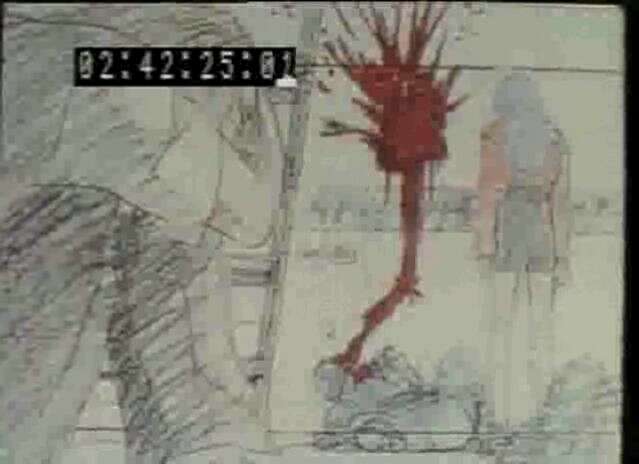
–“The Many Worlds of Neon Genesis Evangelion”
The EoE screenplays that we have archived on the site were written after the TV show, in its original form, was completed, and apparently in tandem with the development of the DC additions. (You can see a note making reference to potential TV revisions at the beginning of the 26’ screenplay.)
It was more abbreviated than Patrick’s. Also wished they used that last line in the hospital scene that was translated from the Evangelion: THE MOVIE page - “I’m fucked up”
It’s actually - “Ore wa saitei da” (I’m the lowest, with all the irony Shinji’s shift from “boku” to “ore” implies) but yes, that’s probably the best translation.
–Zhou Tai An; ‘boku’ is a boy ‘I’ pronoun, while ‘ore’ is stereotypically manly
The cover by Karel Thole of one edition of the obscure & mediocre SF collection, The General Zapped an Angel, bears an extraordinary resemblance to the final scene of EoE; this may constitute another SF reference by Anno in EoE along with the Tiptree allusion.