To expand the ABC GPT-2 model to cover a wider variety of musical genres, I turn to the next-most compact widespread music encoding format: MIDI. There are hundreds of thousands of MIDIs which can be decompiled to ABC format, averaging ~10k BPEs—within GPT-2-117M’s feasible context window when trained on TPUs (which permit training of context windows up to 30k wide).
We compile the ABC from before and 2 large MIDI datasets, and convert to ABC, yielding ~453k usable ABC-MIDI musical files (~5.1GB of text). We trained January–April 2020 on our TPU swarm (with many interruptions), achieving a final loss of ~0.2 (underfit).
Sampling from the final model is hit-or-miss as it is prone to the likelihood repetition trap and it generates instruments one-by-one so it is common for instruments to be cut off or otherwise broken during sampling (indicating that sampling is increasingly a bigger problem than training for long-range sequence modeling). However, successful pieces are possible, and are musically far more diverse than the folk ABC corpus, with many pleasingly complex samples.
MIDI: hard, but not too hard? The logical next step from generating short ABC folk tunes is to generate music in general. Since ABC is not much used outside folk music, there are no good large ABC corpuses appropriate for this. Raw music is infeasible at the moment: things like WaveNet can generate excellent raw audio WAVs like musical notes, but the model sizes prohibit ‘seeing’ more than a few seconds at most, making them capable of playing musical scores fed to them, but not of higher-level composing—struggling to pass more than ~10s even with sophisticated approaches. So you could have a GPT-2 generating ABC which is fed into a WaveNet CNN, creating what sounds like real instruments playing real music, but you couldn’t have a single NN doing it all. Intermediate, more powerful than ABC but also not as demanding as raw audio generation, would be generating MIDI.
Binary MIDI → text ABC. We can’t generate raw MIDI since that’s a binary file format which doesn’t play well with most GPT-2 implementations (although there is nothing in principle stopping operation on full binary bytes rather than text bytes). What if we create a text encoding for MIDI and convert? The most straightforward representation, the piano roll, represents MIDI as 128 distinct instruments per timestep (almost all always silent), which leads to a hopelessly enormous sparse matrix. There are several available tools for encoding MIDI more directly than piano rolls, and one of them turns out to be ABC itself!
ABC-MIDI: still too long for GPT-2… The ABC-MIDI encodings are also relatively short. Checking with wc -w, MIDI files typically range in size from 10–50k characters equivalent; even with BPEs potentially saving some space (it’s ~10.7k BPEs per MIDI), GPT-2 simply cannot handle this sort of sequence (with many important long-range dependencies) with its standard context window of 1,024 tokens, because it would only be able to see less than a tenth of the music file at a time and it would be completely blind to the rest of it, since it has no memory. If you tried, it would not sound nearly as good as the ABC pieces above, because it would be unable to do all the nifty repetition-with-variation of melodies, overall thematic structure with beginnings & endings etc.; instead, it would probably ramble around, generating plausible music which, however, never goes anywhere and just sort of ends. And, as anyone knows, GPT-2 does not scale to larger attention windows as self-attention is quadratic in the window length (𝒪(l2 · d)), and 1,024 is already pushing it for training, motivating the search for new architectures.
Unless we use brute force. However, when training various GPT-2-1.5b models on our TPU swarm using the TPU research credits granted to us by Google’s TensorFlow Research Cloud Program (TRC), we noticed that a TPU can fit a model which uses up to 300GB VRAM before crashing. 300GB—that’s quite a lot. What could you do with that? How bad exactly is GPT-2’s scaling…? Quadratic (𝒪(l2)) ≠ exponential (𝒪(2l)): if you have some good hardware available, you may be able to push it quite far.
TPUs can train 30k context windows! We tried GPT-2-117M and it turned out a context window of 10,000 worked! Then we tried 12.5k, 15k, 20k, & 30k, and they all worked. (For comparison, Reformer generated great excitement for being able to scale up to 64k windows on single GPUs.) These are wide enough to train ABC-MIDI files, and we could even generate small text-encoded images (since 30k = 1732). 30k is slow, but not hopelessly slow, as with GPT-2-117M, we get 4 training steps in 2700 seconds (n = 1). A swarm of TPUs, like >100, would be able to train on a large corpus in just a few wallclock days. The memory usages are considerable, but not beyond the TPU:
12.5k = 45GB backprop
15k = 75GB backprop
20k = 112GB backprop
30k = 280GB backprop
When are 30k context windows useful? For reusing pretrained GPT-2. So, it can be done, but should it be done? Is this more than just a parlor trick reminding us that exponential ≠ quadratic? For the most part, it seems like anyone in need of big context windows is probably better off not renting all these TPUs to train a GPT-2 with 30k context windows, and using one of the many alternatives for long-range dependencies, like Reformer or Compressive Transformers or Sparse Transformers or dynamic convolutions or… But it might be useful in two cases: where one has a model already fully trained, and can do a final finetuning training phase on the original corpus to pick up long-range dependencies, since it’s still feasible to generate with wide context windows on commodity hardware; and where one needs the fully-trained model because the transfer learning is vital, and training one of the alternatives from scratch would nevertheless deliver inferior results. (At least as of 2020-01-30, I know of no publicly-released trained models for any of those alternatives architectures which approach the power of GPT-2-1.5b or T5 etc.—they are all trained on much smaller datasets.)
To get enough MIDIs to be worth training on, I combined 3 MIDI datasets:
The Sessions +
abcnotation.com(our partial scrape), described above-
The Lakh MIDI dataset is a collection of 176,581 unique MIDI files, 45,129 of which have been matched and aligned to entries in the Million Song Dataset…
LMD-full: The full collection of 176,581 deduped MIDI files. -
MIDI Dataset (Composing.ai)
The entire dataset, gzipped, can be downloaded at
https://drive.google.com/file/d/0B4wY8oEgAUnjX3NzSUJCNVZHbmc/view.The directory structure correspond to the sources on the Internet from which we grabbed the MIDI files. We deduplicated the dataset and the resulting collection has 77,153 songs.
Big_Data_Set: “The Largest MIDI Collection on the Internet”cariart: Ben Burgraff’s Midi Collectiondownload-midi: Pop and Rock genres from DOWNLOAD-MIDI.COMGuitar_midkar.com_MIDIRip: midkar.comics: Dan Hirschberg at University of California, Irvinelmd_matched: Straight from the LMD-matched dataset from the Lakh projectTV_Themes_www.tv-timewarp.co.uk_MIDIRip: (Now defunct) TV Timewarp
(I did not use midi_man’s 137k collection, as I only learned about it much later.)
Combined, this yields 537,594 MIDI files (~9GB).
Need compact text versions of MIDIs. The problem with raw MIDI files is that they are binary, and not textual. The codebase does not support binary inputs as far as we know, and in any case, text is always much easier to inspect and work with. There are textual formats for MIDI, like hex encoding, and one can use generic binary → text encodings like Base64, but I was not too satisfied with them: when I tried them, they often blew up the character count greatly, and even 30k context would not be enough.
ABC works well enough. Ironically, ABC turns out to be the answer! The ABC tools ship with midi2abc, which is the inverse of abc2midi, and while it warns that it is a lossy translator, after listening to a few dozen, I had to say that it does a good job overall. It also generates ABC files which are similar in size to the original MIDI files. (I think that whatever midi2abc loses in having to potentially laboriously encode MIDI constructs, it makes up in being able to take shortcuts using ABC’s higher-level music constructs.) The weaknesses of midi2abc is that it: loses volume control, doesn’t work well on some rock tracks (drums/guitars are hollowed out), doesn’t successfully compile many MIDI files (leaving empty or extremely short ABC files), and there are occasional pathological examples (eg. one 44kb MIDI decompiled to a 3.4GB ABC file—some exponential blowup?). However, the first two are relatively minor, and the third can be tamed by simply dropping ABC output past 300kb (as hardly any non-pathological MIDI files compiled to >300kb).
Data cleaning. In converting the files, we want to avoid excessive use of newlines (-bpol 999999), we want to delete various warnings or error lines, we want to filter comments starting with '^% '—which take up a ton of space and often are just lyrics—and then delete spaces in non-MIDI-directive (^%%) lines per the ‘spaceless’ model above. The shell pipeline:
## delete odd trash files in LMD/Composing.ai
find . -type f -name '\._*' -delete
## clean up conversions from any previous runs
find . -type f -name "*.mid.abc" -delete

function convertMidi2Abc() { midi2abc -bpl 999999 -nogr "$@" |  \
 grep -E -v -e '^% ' -e '^w:' -e 'Missing time signature meta' \
          -e 'All rights reserved' -e 'Error ' -e 'Copyright' | \
 ## ABC MIDI commands start with '%%', but regular comments start with '%', so drop any line with '%' but not '%%' in it:
 sed -e 's/^%[^%].*//g' | \
 ## delete spaces inside non-MIDI commands (MIDI, but not ABC, commands are space-sensitive):
 sed -e '/^%%/! s/ //g' | \
 ## a handful of files are pathological, so truncate:
 head --bytes=300000 > "$@".abc; }
export -f convertMidi2Abc
find . -type f -name "*.mid" | parallel convertMidi2Abc

## below 150 characters means an ABC file probably contains only metadata
find . -type f -name "*.abc" -size -150c -delete

## create training (19/20) and validation (1/20) file lists:
find . -type f -name "*.mid.abc" | shuf > filelist.txt
split -n l/20  filelist.txt split
The file-lists can be used to read in individual files, intersperse <|endoftext|>\n, and write them out as a single GPT-2-formatted text. A shell loop proved too slow so I wrote a simple Haskell script:
{-# LANGUAGE OverloadedStrings #-}
import Data.ByteString as B (concat, readFile, writeFile)
import Control.Monad (liftM)
import Data.List (intersperse)
main = do files <- liftM lines $ Prelude.readFile "training.txt" # 'splitaa'
          contents <- mapM B.readFile files
          let contents' = Data.List.intersperse "<|endoftext|>\n" contents
          B.writeFile "foo" (B.concat contents')
5.2GB of ABCs. The final results were 453,651 ABC files (~10k BPE/ABC?):
2020-03-30-abc-combinedmidi-training.txt: 4.9GB (430,928 ABC pieces)2020-03-30-abc-combinedmidi-validation.txt: 263MB (22,723 ABC pieces)
A sample of 50 randomly-chosen (excluding The Sessions) human-written MIDI files:
The full dataset (all MIDIs, ABCs, file-lists, and GPT-2-formatted text files) is available for download:
rsync -v rsync://176.9.41.242:873/biggan/2020-03-30-mididataset-abcnotation-thesessions-lmd_full-popmididatasetismir.tar.xz ./Curriculum training. We initially trained with a ~27k context window, but iterations took multiple seconds, and after we took a second look at the ABC conversions and saw that pieces averaged only 10.7K BPEs, decided that was largely a waste, and switched over to 5k context windows. Due to repeated TPU preemptions and delays in restarting training and some ill-timed learning rate decreases, it wasn’t until late March 2020 that we got noticeably good samples at a loss of ~0.22/10m steps on 2020-03-24. (Thank goodness for our TRC credits! Even with TPUs covered, the final total cost of the VMs/bandwidth/storage was >$1,257.78$1,0002020.)
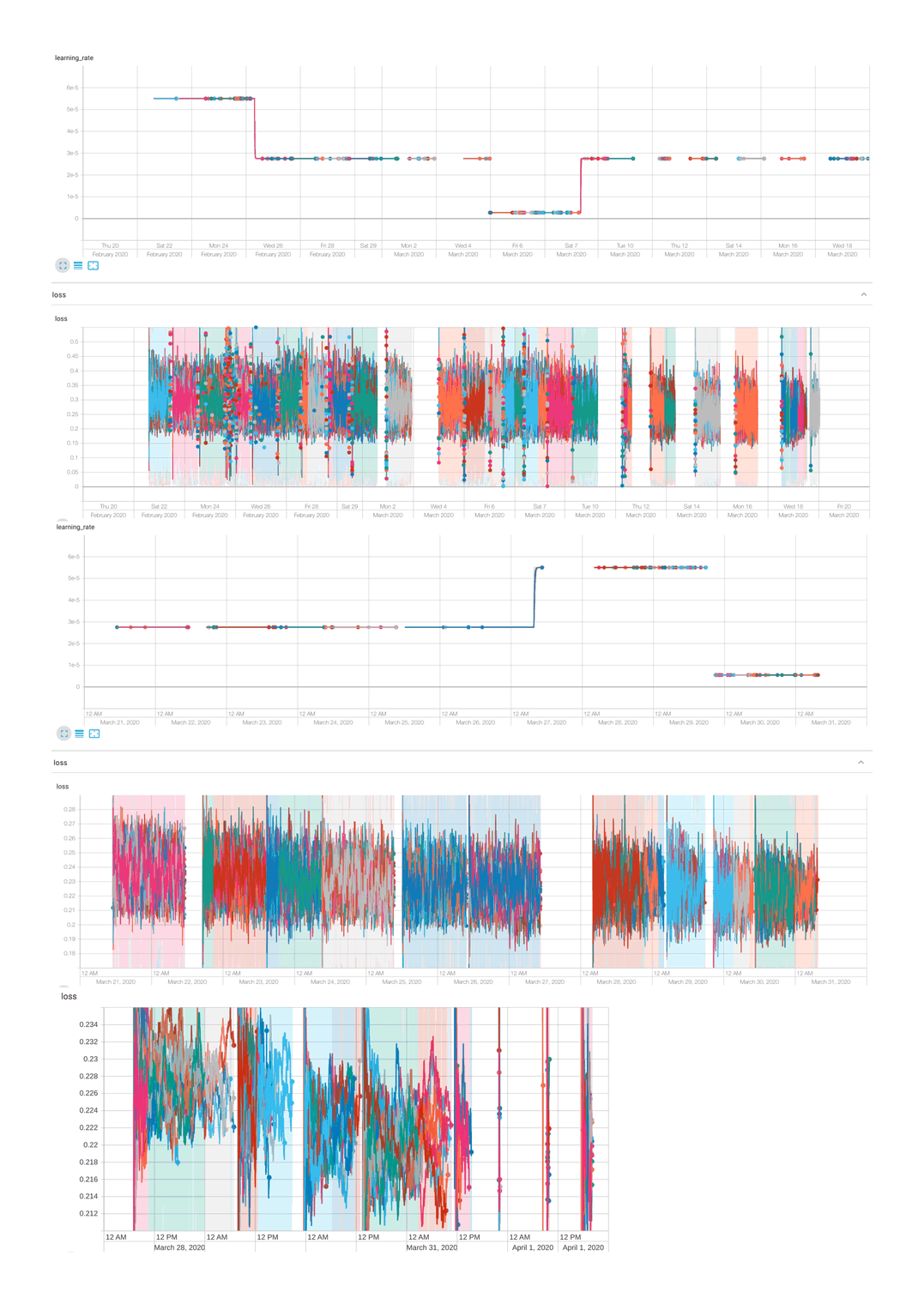
Swarm training loss curve, ~2020-02-20–2020-04-01, ~18.9m steps (repeated interruptions)
Converged—underfit‽ Around 4 April, with the 5k context training apparently fully-converged, we switched back to ‘coreless’ mode and 10k context windows and trained to a loss of ~0.20. It was stable at that loss, without any further decrease, for many steps, so, interestingly, I suspect GPT-2-117M turns out to underfit our MIDI dataset while being able to overfit the earlier smaller ABC datasets. If I had known we’d be able to hit an only loss of 0.2, I would’ve started with a larger model than just GPT-2-117M, and accepted any necessary limits on context window. Since likelihood loss seems to track quality so closely & the final few increments of loss make a big difference perceptually, it’s possible we could’ve done a lot better.
Sampling problems—divergence+gibberish. Generating samples from the 10m checkpoint proved unusually tricky, despite nucleus sampling, with high risk of repetition or degeneration into pseudo-English-lyrics/text. A round of data-cleaning to remove that fixed the degeneration into pseudo-English, but left the repetition problem: sampling remains prone to generating hundreds of lines of repeating notes like z8|z8|z8|z8| (which is especially slow once the context window fills up). These repetition traps (so common in likelihood-trained NN models) appear to go on indefinitely in my sampling, and high temperatures/top_p parameters do not break loops. The sheer length of pieces appears to exacerbate the usual issues with repetition—a sampling process which is fine for a few hundred tokens may nevertheless frequently diverge as required lengths approach 10k. (Given that extremely long sequences of z notes are common in the original ABC-MIDI datasets, this suggests that a custom BPE encoding—unlike in my earlier poetry or The Sessions datasets—would be helpful in collapsing these common long sequences down to a few BPEs.)
Failure mode: dropping instruments. Strikingly, pieces tended to be either good or fail entirely, possibly because instrument/tracks are generated one at a time, and syntax errors or early termination of sampling can disable entire instruments, leading to silent tracks and a final music piece which simply repeats endlessly (because the melody & variation would have been provided by a failed or nonexistent later track). To reduce the impact from divergence while trying to avoid truncating potentially-good pieces early, I use the repetition penalty from Nick Walton’s AI Dungeon 2 (itself borrowed from CTRL), and set a 10k length limit on samples (corresponding to the average length of an ABC-encoded MIDI), and generate 10 BPEs at a time to speed things up (1 BPE per step would theoretically give better results but is extremely slow):
python3 src/generate_samples.py --top_p 0.95 --penalty 0.65 --prompt "\nX:" --model_name midi \
    --length 10000 --n_ctx 10000 --nsamples 10 --batch_size 1 --step 10 --maxlen 10000
Because of the sampling fragility, there is little point in providing a dump of random samples to listen to (although I provide a text dump); instead, here are hand-selected samples representing roughly the top 5% of samples. All samples are generated using the default Timidity settings, timings, and soundbanks (eg. no use of harps like Shawn Presser’s modified samples before),
Samples from iteration #10,974,811, loss ~0.22:
-
MIDI sample (2020-03-24); electronica/instrumental -
MIDI sample (2020-03-24); electronica -
MIDI sample (2020-03-24); jazz (particularly nice use of a saxophone track) -
MIDI sample (2020-03-24); classical piano piece -
MIDI sample (2020-03-25); classical fugue-esque harpsichord/organ
From the final models:
-
Big Dataset (notable for its drum+bagpipe-like duet) -
(2020-04-11); fast jazz saxophone piece? -
LMD folk-ish piece (heavy on a woodwind/organ?) -
LMD: catchy ambient-esque piano piece -
Pop MIDI, rapid jazz piano? -
Pop MIDI, almost video-game orchestral-like in parts -
(2020-04-15); LMD piano piece -
LMD piano piece -
LMD slow classical -
Pop MIDI, guitar rock -
Pop MIDI piano -
The Sessions jig -
The Sessions -
The Sessions -
The Sessions -
The Sessions -
The Sessions -
The Sessions -
The Sessions -
The Sessions -
The Sessions -
The Sessions -
The Sessions -
The Sessions (Steve Martland-like?)
-
The Sessions -
The Sessions -
2020-04-18 samples: ABC -
Big Dataset -
Big Dataset -
Big Dataset -
Big Dataset -
Big Dataset -
Big Dataset -
Big Dataset -
Big Dataset -
Big Dataset -
Pop -
Pop -
The Sessions -
The Sessions -
The Sessions -
The Sessions -
The Sessions
Better but frailer. Quality-wise, the MIDI model is capable of much more diverse pieces while still generating good folk music, illustrating the benefits of switching to a much larger dataset. Although the difficulty we had training it means I do not recommend using GPT-2 for such long sequences! (Fortunately, there are many technical solutions to the immediate problem of self-attention’s quadratic cost.) But after the task of training with wide windows is solved, there is not yet any solution to the problem of sampling. It’s hard to not notice that the good MIDI samples are more repetitive than the small ABC samples; this could be due in part to issues in sampling breaking additional voices & leaving the backing tracks (which are supposed to be repetitive), and could also reflect greater repetition in MIDI pieces intended to be several minutes longer as opposed to curated ABC folk music pieces which tend to be quite short (as performers will vary & repeat as necessary while performing), but one must strongly suspect that the sampling process itself is to blame and nucleus sampling is far from a solution. Were we to train a larger or longer model which can model tens of thousands of tokens, how would we sample tens of thousands of tokens from it?