In keeping with its gradual rollout plan, observing no particular misuse in the wild (aside from a few anecdotes about content mills), OpenAI released the final and largest model, GPT-2-1.5b, in November 2019 along with detection tools (paper) The model was an easy upgrade for services like Talk To Transformer which simply sample from the original model, since it still fits easily onto commodity GPUs.
From November–December 2019, Shawn Presser & I worked on finetuning training GPT-2-1.5b on the combined PG+PF poetry dataset from above. The 1080ti GPU approach failed, so we switched to Google Colab to use the free TPUs. Colab worked, but constant failures made it painful to contemplate multi-week training runs, and so we switched to GCP to use TPUs directly. Direct TPU use is much faster, but the errors remained, so we began working on a distributed TPU approach, to work around individual TPU errors. Eventually, using Google TRC research credits to pay for TPUS, we began running TPU ‘swarms’ of <60 TPUs (since scaled to <200). These produced meaningful training progress and we reached a loss of ~2 by 2019-12-12.
We were able to train it to ~1 loss, but it appeared to have overfit in some fashion as sampled qualities became increasingly worse by the time we halted ~2019-12-20, so we settled for iteration #500,522.
Download: samples, checkpoint
Training is a different story. 345M took ~7 days to train, and GPT-2-1.5b is 4.4× larger, so that alone implies a training time of a month. Worse, where GPT-2-345M fits in reasonably in a 1080ti’s 11GB VRAM & 745M just barely fits, GPT-2-1.5b does not fit at all.
We began trying to train on the combined PG+PF corpus, like the GPT-2-117M model I trained for RL preference learning, but turning on all the options in the nshepperd repo doesn’t fix the memory problems. (FeepingCreature was able to train on his new AMD GPU, which has 16GB RAM, so a few more gigabytes would’ve done the trick..)
Using Shawn Presser’s fork of nshepperd’s fork, we experimented with alternatives like using reduced-precision, truncating parameters to FP16. This caused serious errors. After fixing those errors, and reducing the context window by half (potentially hamstringing it), we could train GPT-2-1.5b on a 1080ti, but our naive conversion to FP16 appears to have seriously damaged the model and it emitted only garbage. We then tried using a different floating-point format, bfloat16, which in theory is much better suited to NN models than FP16 & natively supported on TPUs, but it trained extremely slowly on my Nvidia1080ti GPU. Given the daunting expected training time, bfloat16 was not a solution.
The only solution here seemed to be to abandon my 1080tis and upgrade to TPUs. TPUs may not be any faster, but they have far more RAM and can train a GPT-2-1.5b with no problem.
How to get a TPU? Fortunately, Google Colab did just enable free TPUs by default… So Presser enhanced his fork to support TPUs, and we started training.
Unfortunately, Colab notebooks are still limited in system RAM and disk space, so training GPT-2-1.5b then encountered the surprising problem of running out of RAM & crashing, running out of disk space, and saving to disk being extremely slow due to slow TensorFlow serialization of the model checkpoint. (The TPU-based serialization code would have been far faster using the standard TF way, but it would also required the user to create & manage a Google Cloud bucket; we were still hoping to create an easy works-out-of-the-box Colab notebook to let anyone do GPT-2-1.5b-finetuning. If there was a faster way to do it, Presser didn’t know about it.) This was partially solved by saving few checkpoints, figuring out how to attach a Google Drive folder (after paying $2.55$22019/month for an upgrade to ~100GB of additional space, since the default 15GB Google Drive is perilously small), and further work on optimizing the serializing. Training was slow—1 minute per minibatch, initially—but did work. An example:
...2019-11-12T18:18:02.411370-08:00 [601 | 13372.9633 | 67.76 | 0.059033/s] loss=3.5624 avg=3.5139 rate=0.000020 step=185

Thee, thou fount of every flower,
And, in thy fair, golden-red ring,
A golden-colored rose,
That was once a bloom I knew.
Now, if the sun ever wets the tree,
The leaves shall turn once more to gold,
Thine, as the rose will be to you,
Like a sunbeam in a rose-color'd sky.
Thus we praise thee as a sweet flower,
Not only as a sunbeam,
But, in thine earthly bloom,
As the sunbeam when brightest.
Thus we praise thee for ever.

From thy golden, heavenly rose,
Which is the sun,
From thine ever-changing gold,
Wherever it shines,
As a heavenly beam
That never fades.
Thee, oh,
Thee, golden sun,
As ever-flowing,
Presser tried out curriculum learning/progressive growing by setting the context window to a small window like k = 50 BPE tokens, with the idea that it could be gradually annealed to the original k = 1,024 over the course of training. (Because of how Transformers scale, k = 50 uses far less memory & compute than k = 1024, so it fits much larger faster minibatches.) This seemed to be working to some degree, but it was no silver bullet.
Exacerbating the problem, TPUs on Colab appear to randomly ‘freeze’, an issue unrelated to Colab notebooks timing out after a day or so; manually interrupting the training process and restarting fixes it, but at the cost of any progress made since the last (slow) checkpoint & required constant babysitting; I calculated that one would have to checkpoint every hour to optimize the tradeoff between freezes & checkpoints! At one point I was dealing with TPU freezes every half hour. It was already giving decent poetry samples despite a loss >3, but we wanted to train to convergence, which ought to be <1.6 (the final combined-117M loss).
This was not going to work for weeks of training. Presser again modified the codebase & notebook to add ‘watchdog’ processes which would watch for an apparently hung TensorFlow process due to a TPU freeze, and kill it and restart. But the lost time was a serious issue: we couldn’t checkpoint too often because then we’d waste all our time checkpointing, but not checkpointing meant we’d lose minutes or hours of training. We couldn’t find any information about why TPUs would freeze and figured it was some sort of Colab issue, so I decided to bite the bullet and pay for a GCP VM & TPU.
A preemptible TPUv2 costs $1.72$1.352019/hour, which is not too bad… A week of training would cost >$288.32$2262019 & I’d never used GCP before, but I was too curious what a fully-trained GPT-2-1.5b would generate. The net cost for November 2019, due to all the experiments and costs not covered by the TRC research credits, was $410.12$321.472019, primarily for high-RAM instances, and then network egress bandwidth fees—for cross-zone traffic with the TPUs, apparently. Optimizing for GPT-2-1.5b-poetry, we got December 2019’s cost down to $254.87$199.782019, and trained GPT-2-1.5b-poetry and an IRC logs model. We spent in January 2020 an additional $513.45$408.222020 on a number of projects: the chess, Subreddit Simulator, Archive Of Our Own, and video game walkthrough GPT-2-1.5 models; the 30k context window GPT-2-117M ABC/MIDI model; ImageNet resnet benchmarking; and StyleGAN 2 prototyping for training on Danbooru2019.
After setting up on GCP and figuring out the details like needing to set an environment variable with the target TPU name, we discovered… the TPUs kept freezing anyway. This was on top of the standard preempting of TPUs, since we were using preemptibles to save money as is standard in cloud deep learning. This remained a mystery. Was there some undocumented heartbeat that was required? Was Presser’s TF code, which avoided the standard TPUEstimator approach which it seems everyone else uses, triggering some sort of problem? (We were warned in vague terms that TPUs do not like loops or reshaping operations.) Even more irritatingly, our on-demand TPUs turned out to preempt anyway! But at least the checkpoints were fast, so now the watchdogs worked better. But on the gripping hand, the TPU was not fast and was performing far below what we thought it should based on its nominal specs, and we seemed to be using barely a third of the cores.
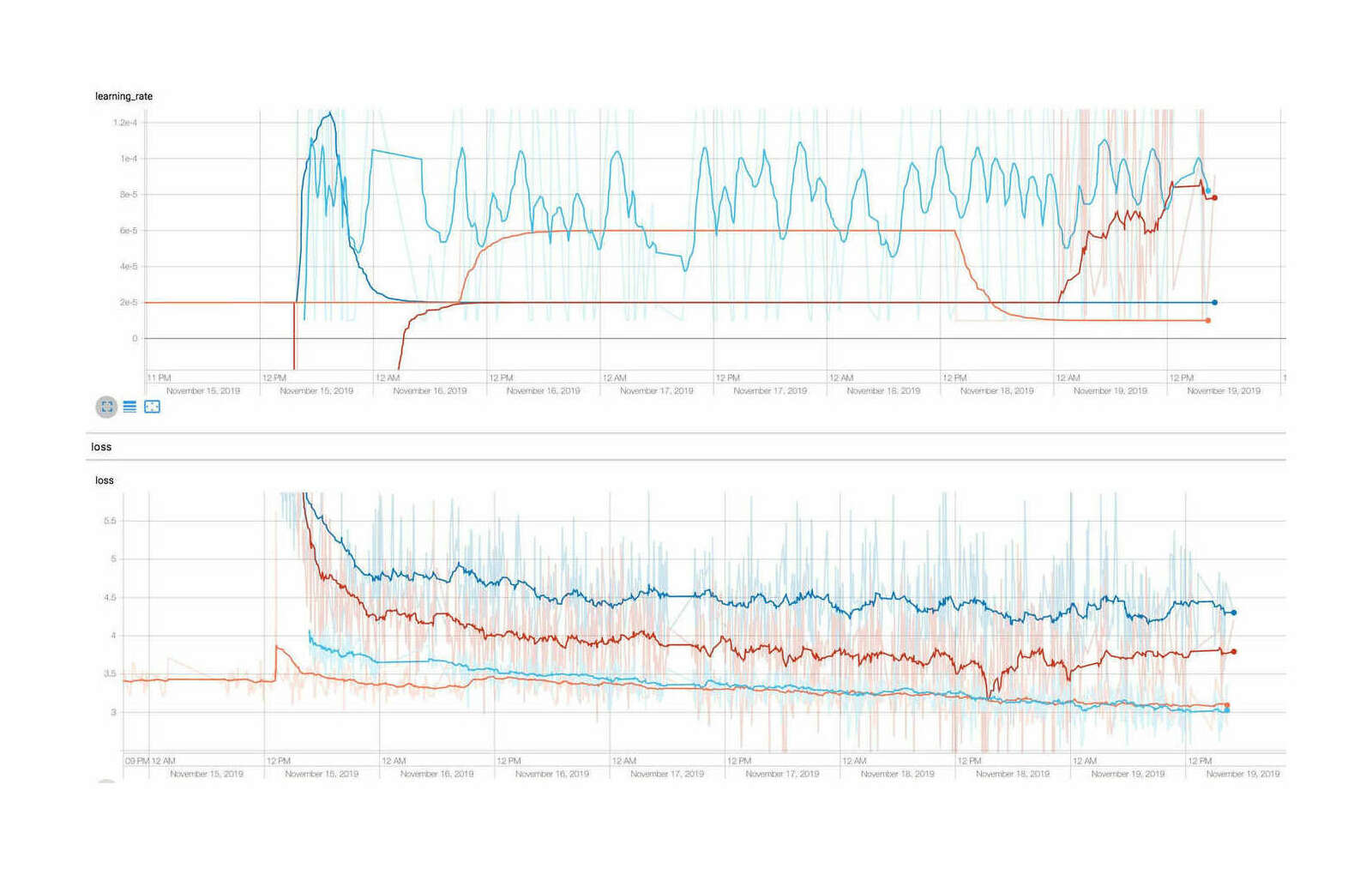
GPT-2 model training curves over 4 days on 1 TPU each: GPT-2-1.5b (orange), 774M (light blue), 400M (red), ‘tiny’ reduced context (dark blue)
Presser decided to press on and after further optimizing work to ensure we used the full TPU RAM and more of the cores with a minibatch n = 4, began experimenting with support for multiple TPUs. Since each TPU is a separate computer inside Google’s network, and not ‘attached’ to a VM like a GPU, there was in theory little limit to how many TPUs our 1 VM could orchestrate. We could, in theory, create an equivalent of the expensive TPU ‘pods’ by simply connecting to a bunch of TPUs at once.
The main limit for distributed TPU training is the network bandwidth: copying around the latest version of the multi-gigabyte model to and from the central VM uses up all the bandwidth available. In the simple synchronous case, which most closely approximates training on a single GPU, if the entire cluster has to stop and wait for every node to copy its updates to the master, the master do a single batch update, and the master sync back out to each node, the cluster will spend most of its time just waiting on the network to copy everything. (And what happens when one or more TPUs inevitably freeze?)
Presser worked around the bandwidth with an asynchronous approach somewhat like the old HOGWILD training method: instead of every node copying its entire model at a fixed timestep and waiting for all the other nodes, the nodes are constantly communicating a fraction of their latest model with the master and receiving an updated fraction back, regardless of how many iterations other nodes have run. So every node is running a hybrid & partially-out-of-date model and sending stale gradients out, but gradient descent is robust enough that this will still work and will scale up easily. After enough slices have been sent, a node will have sent an equivalent of a full model, and caught up partially, and the ‘swarm’ will hopefully be able to make progress by training on a large amount of hardware and be faster than using just a few TPUs synchronously.
A swarm was too expensive for me, so we applied for TensorFlow Research Cloud credits. I wasn’t expecting anything to come of it, but the form was easily to fill out in a minute (it’s not much more than an email address), and to my surprise, within 3 hours we had been approved for 1 month of credits, covering several on-demand TPUv2–3s, and 100 preemptible TPUv2s (but no TPU pods).
Presser began the long and painful process of debugging the swarm and all its problems… The halts were never quite fixed but we kept scaling.
By 2019-12-11, after applying for additional credits because we were coming up on the TRC deadline on the 14th, we’d gotten the loss down to ~2.15. After switching to Adam and scaling the swarm further to ~95 TPUs on the 13th, we reached a loss of 1.61, matching or beating the GPT-2-117M record on the combined dataset. A further 5 days (interrupted by swarm preemption and occasional tweaks/experiments) brought the loss down to <0.6 on 2019-12-18. I had expected flagrant plagiarism/overfitting well before a loss of 0.6, perhaps ~1.2, but regularly inspecting unconditional samples and searching initial lines or generated titles/authors, I found little & they didn’t read like plagiarism, so we kept training to see how far it could go. (Prompting with lines from famous poems would’ve almost surely elicited plagiarism, but I am less concerned with that, since GPT-2-1.5b is so big it can easily memorize famous poems without compromising its general poetry abilities.) I suspect that GPT-2-1.5b is not really >3× better than GPT-2-117M, and that GPT-2-117M could have been trained to <1.6 loss if we had used similar amounts of compute, so the actual benefit from scaling up GPT-2 is smaller—but why bother with training GPT-2-117M to a better convergence when we can use GPT-2-1.5b?
Example training curves:
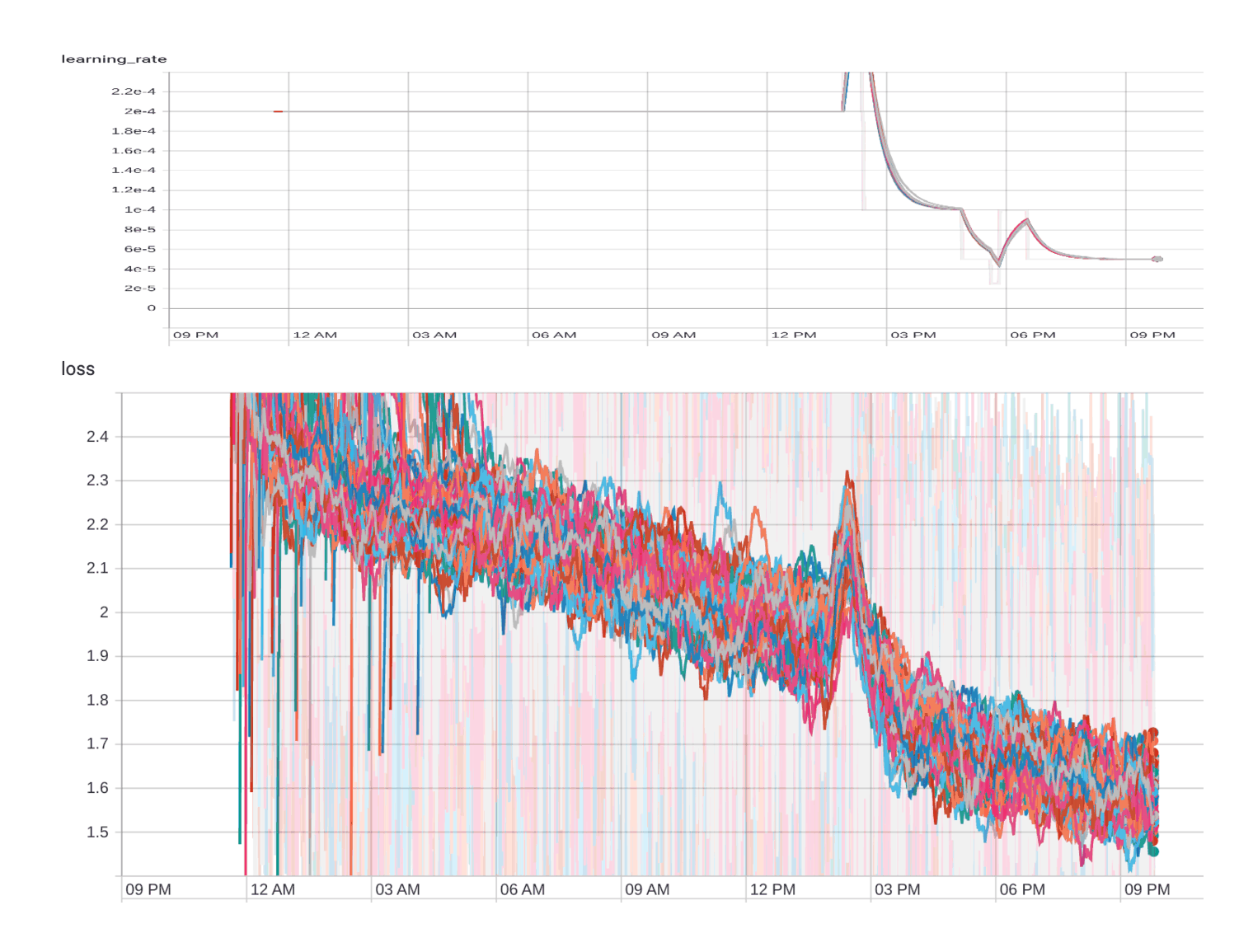
Training curve of a swarm of ~97 TPUs training GPT-2-1.5b-poetry for ~21 hours (2019-12-13) from a loss of ~2.15 to <1.6.
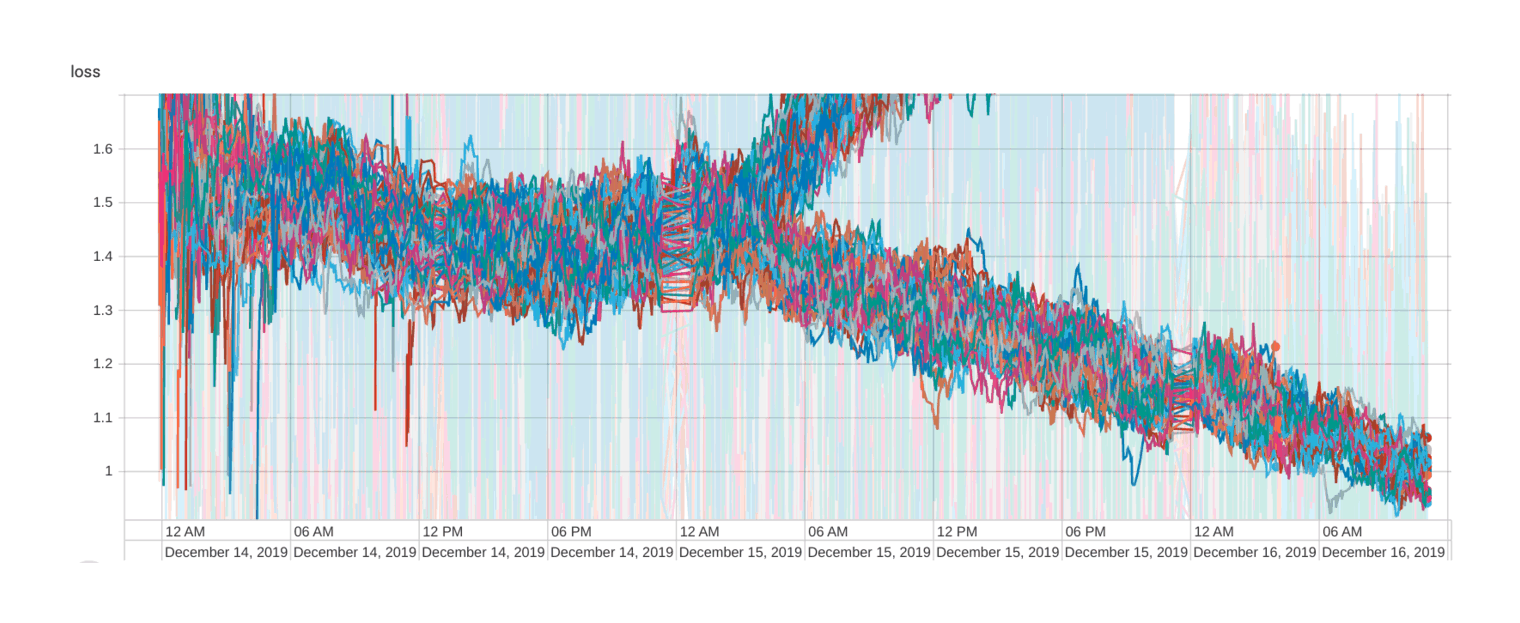
100 TPUs, 1.6 → 1 loss (2019-12-16)
While sampling, we noticed double and single quotes were being replaced by mojibake gibberish. This appeared to be due to Unicode curly quotes (""') in the original text dataset. The GPT-1 paper mentions using the ftfy Python library to clean up mojibake & Unicode in their crawl data, and ftfy converts Unicode quotes to the ASCII straight quotes, so presumably GPT-2 does as well and it (or its BPE encoding) is confused by their presence, causing the mojibake output. It was late in training, but we updated the PG+PF dataset to replace the quotes (ftfy.fix_text('foo') etc.).
One issue worth noting was the problem of regularly restarting the swarm due to preemption & TPUs expiring, which caused large loss spikes on startup that would waste hours of training as it recovered; as a compromise between simple SGD and full Adam, we were using Adafactor (as most Transformer projects do, like Connor or Gokaslan’s GPT-2 replications), and we speculate that the loss spike is related to losing optimizer state and bad initial variance estimates. Simple SGD avoided the loss spike, but at the cost of making no discernible progress regardless of LR; Adafactor made slow progress, but wasted a substantial fraction of available training time; we tried to avoid Adam because the memory overhead of tracking momentum for all variables (as opposed to Adafactor’s simplified approximation of momentum) would reduce minibatch size, but when we tried Adam on the full swarm, despite the initial loss spike, it made much more rapid progress than Adafactor did.
I suspect that the issue here is that though simple SGD & Adafactor worked fine when running on a single GPU, in the scaled-up asynchronous swarm setting, they have especially poor gradient estimates and make slow progress; the loss spike comes from the optimizer state being reset on startup, causing early gradients to be poorly estimated & destabilizing training, requiring thousands of iterations to gradually recover. Adam then improves over Adafactor by estimating true variance/momentum, overcoming gradient noise to make faster progress. If so, the spike issue could be fixed several ways:
Don’t Reset The Optimizer: the simplest way to fix the spike caused by resetting momentum estimates is to not reset them; save the optimizer state along with the model, and restore on startup. This is somewhat unusual for TensorFlow projects (I see more PyTorch implementations serializing optimizer state) but shouldn’t be hard, and only comes at the cost of using more diskspace for checkpoints & more bandwidth at startup, which would be more than worthwhile to save hours of recovery time.
Learning Rate Warmup: if the initial updates are highly destructive because they use bad momentum updates and it takes a substantial number of iterations to re-estimate the correct momentum updates, then don’t update much initially; use small LRs to avoid destabilizing the swarm while still re-learning the momentum. After some iterations, the updates should be safe to use again and the LR can be increased to the normal LR.
Gradient Accumulation: another way to reduce the damage of initial updates is to greatly improve their accuracy, and keep the swarm more in sync, by doing fewer but better updates; instead of each node doing local updates immediately after each tiny local minibatch, the nodes store gradients and average across many minibatches before doing an actual update, thereby faking having large updates. This will also improve the momentum estimates, as the momentum is estimated across many minibatches before it affects any update.
Partway through, having reached a loss of ~2.6 (down ~0.5 from the Colab model), we experimented with training our model on a P100 GPU, halving the context window to make it fit, to informally compare its training speed with the swarm. The P100 made little training progress, but it did generate some fun poetry samples (we had disabled the training sample generation for the swarm because generating samples is so slow).
The samples strike me as good, perhaps even better than GPT-2-117M, despite the loss being much worse (2.6 rather than 1.6). Why might that be?
I hypothesize it reflects a weakness of the likelihood loss in terms of perceptual quality: humans are more sensitive to long-range correlations and text degenerating into gibberish than we are to local details like exact use of particles or to slightly better modeling of spelling (which is why stylometrics works). The original OA GPT-2-1.5b achieves much better modeling of long-range correlations and producing coherent text than the GPT-2-117M did, of course. What happens when they are both trained on a poetry dataset? It is the tale of the tortoise & the hare, or the bias-variance tradeoff: the GPT-2-117M is weak, bad at long-range modeling because of its small parameter count & shallow layers, but the benefit is that it can learn quickly about local details like spelling, and, achieving good prediction there, converge to that 1.6 loss; GPT-2-1.5b starts off good at long-range modeling and good at short-range modeling, and must tradeoff learning both from its limited training, thereby achieving mediocre performance on local correlations and thus mediocre loss, even though humans reading it are impressed by the thematic consistency and relative lack of ‘gibberish’ (locally but not globally consistent text).
An additional issue here is that the GPT-2 models are not fully trained: as the GPT-2 paper notes, “All models still underfit WebText and held-out perplexity has as of yet improved given more training time.” (The difficult of training such powerful LMs to convergence was also noted by the MegatronLM researchers, whose MegatronLM-8.3b model was still learning rapidly when they ended the training—despite use of NVIDIA’s DGX SuperPOD with 512 GPUs.) So some of the finetuning here may also be finishing the GPT-2 training.
I selected the following from its training log.
A commentary on Oda Nobunaga’s mysterious betrayal by a loyal general?
"Oda on the Pavement", by Mark Bibbins [Activities, Jobs & Working, Social Commentaries]
The first time I saw this sign someone's blood
streaming down the pavement, I didn't know what to do.
I walked as quickly as I could toward the body
and almost didn't see the second because it was going by
so quickly I had to blink and it was gone.
But this is what I saw when I got there, a corpse
laid out flat on its back, its legs
bent at the knee, with a blue tattered blanket
crammed in the small of its back.
I said to my wife sitting next to me, don't you
think this is awful? She said, Mark, it looks like
just a trick he's done.
I said, it looks awful real to me. The man has
his back turned to us, like he is not even thinking.
As I am, I said to my wife, is this what you have
been waiting for? Is this what you have been waiting for?
The man was lying there not even looking up at us.
In the Golden Age, when the people of the Yellow Valley were instructed by the sages of antiquity:
...That the earth would then not open
(O, but to hear our fathers speak!),
The angel of the waters spake.
For in that time the race of man
Sought the groves, each his own dwelling,
Where were then fruits to satisfy,
Where were trees in plenty springing
To furnish them with fuel,
And so the forest grew,
And o'er it all was running
The river that we see.

Then did those ancient sages
Order their days as was fitting;
And whatsoe'er they looked
On was ordered rightly; all
Taught each what was fit for living
And working for self;
And now we have come to the end,
But this is what their teaching
Said for our instruction,--
That we know and do not know,--
And yet we know and do not know!

When we have found that which is right
The will to act and not to act
To be the chief and not the end,
The day and not the hour,
The joy and not the pain,
When shall we find this, then at last?
Why then at last at last?
There can be no yesterday
If such be the age of wisdom;

There can be no time or place
If such be life and work for man;
There can be no man or man's child
In which he has no friend or friend's child;
Nor yet a man or man's son,
Who to his work does not go.
Thus the sage's order is
And what the sage does--so he does.
Romance?
...I know my father taught me,
To count your blessings and forgive
The people who are wrong;
But I think, when my day is done
And life is all in strife,
Perhaps the one good man who isn't yet
Will find the way to see
Why men die, the reason lies
In the people, never the least in them.

To-morrow it may have been a woman's hand
Caught his in the doorway,
And I may laugh to-night at a stranger's sigh,
Just as I did yesterday.
But what if he and I are dead?
What matters it?  For God's sake, listen to me!
If God finds out
That I am not as I should be,
Then I shall surely pay the price--
That is if He will be just.

I think my father loved me,
And was glad I was his son.
I say to-night I see it every day.
I say to-night I know it all.
And why should I fear
What my son thinks, what he does?
I should be mad to doubt it,
For aught my father says.

I shall find out when I grow old,
And say to my soul, "Be glad
That things that are may be,
For if things were worse, why, we'd have things worse."
And, knowing what my soul knows,
I shall be glad for the things I shall miss--
For God's sake, I shall be glad!

A man's true worth is revealed to you
When, by the light of your own soul's light,
And God's, you look at his;
You can feel them both shine through you
Like a glory you could shatter
Just as a crown could shatter you
Into thousand pieces that were bright
And perfect, and eternal.

And so no other can you see and know
Except his soul.  As the rose of him
Sends back in glory back its hue,
So does the soul of one reveal
The beauty of another.
Be mine the glory to know it best
When my soul shall look at its own.

O great and blessed Lord,
Who made the earth, the heaven, and the sea.
I who am standing in these holy places,
Be grateful
A nice descriptive piece:
...The sun sets and rises in its glory
And sets in its glory only.
And the stars are all that can be seen up there,
That set and rise and come to the earth in their glory.
And the moon, too, sets and rises only,
And comes to the earth in its glory.

The sun sets and rises in its glory,
And when it sets, the night is black,
And when it sets, the day is dark.
The sky is all up against us and over us,
With its starry light,
And all the earth beneath us and above us,
Under the shining sky,
Is black with all the stars.
An elegy:
..."To the Youth", by Susan Greenfield [Death, Growing Old, Sorrow & Grieving, Relationships, Family & Ancestors]
For the youth, who, long ago,
Came up the long and winding way
Beneath my father's roof, in sorrow---
Sorrow that I would not bless
With his very tears. Oh,
My son the sorrowing,
Sorrow's child. God keep thy head,
Where it is dim with age,
Gentle in her death!

And though the years should bear him low
Into the world's dark embrace,
He shall feel more fondly there
Than he did in my bosom then.
Even now that heart, so wild,
Is as a child's, sweet, and calm;
And shall His voice forbid me
From the shadow of the grave
To forget, to forget Him?
And shall He care to keep Him
As I do him here in this place?
Or has the power, that I have learned
Him of the world to fade,
Him of the world to go away?
Haltest to the shadow of the grave,
My son, my son!
Love lost:
...Since that fatal day we parted,
I have lost, I think, my best part.
It was a friend of mine once gave me breath,
And I went as far out as he dared to go,
And ever since, poor lad, I've lived by drink.
But if I had no more friends, I had friends
Such as the world could never let me have.
'Tis true, I have never had occasion to think,
But when the sun is high, and the sky is green,
And the whole world is merry till the break of day,
I sit and dream of her and of the joys of yesterday.
And I go wandering off on some old-world morn
Whose very first light of hope and youth
Is the light of looking on her face through the green.

Her eyes where they were, as I tell you,
Seem fixed with a bright, fixed gaze;
They're half my heaven, when they are there!
They are as clear and bright as she herself,
And she knows, too, the way that she will look
When I can tell her what she is like
And where all will end for me in her.

Now, how would the world like her if it knew,
And what would 'twere if each one did know;
For, ah, she is a world of beauty!
But then, ah, her eyes are even as clear
As the light that makes them bright and wise.

And they are a light out of some dream
That has power to brighten and cheer;
They're a bright sign to turn and turn again
Even in the days of storm and pain;
They're my world, like her bright suns of heaven,
Which I have loved even to the death!
An attempt at nonsense verse, apparently:
...I had a little hen,
I had a little hen,
It chirped at her dish.
She chirped at her dish,
"Come in, come in,"
The dish clattered out,
The dish opened wide,
There were three small cats,

"What is the meaning of this,
Why are all my dishes
Spread open for you?"
"Sit in the corner."
"Here is a bowl for you!"

She drank the bowl clear,
She drank the bowl all up,
And cried with an unhappy sound,
"I do not want it!
I am quite sufficient,
I shall have enough,
And just be done with it,
And not have more!"

But I have a different tale,
Which perhaps you will think is odd.
It is, 'tis no use repeating.
But here, it may be the same.
I had a little hen,
I had a little hen,
She had a little curl,
That with her beak she curled,
In her plumage she had,
Such as a dog's must have.
Thus I had three little dogs.
I fed them with bread.
And they all looked out upon the street
Where our little Polly went by.
The wreck of a ship:
...And as the sun sways to and fro
With his eternal sway of air
They roll in slumberful rest.

So still and calm are they,
So still and clear,
No whisper of the wind dares steal
The tranquil atmosphere of night,
And like bright angels sleep.
The sea is their only theme,
The ship is a dream
That they arise to leave at even.

The moon is far,
All glistening with a silver shine.
It is her pale that lights
The livid face of the sea
That in its white and sullen face
Is pale with pain.

O grey and grey it grows,
And the sea grows wild
As the black clouds in a night-time ride,
The storm is on the sea,
The wild winds rush in their strong wrath--
The great waves roar and beat
The heart of the ship with their fury--
In its heart's core, cold and dead
At one bound, is bound
Like a rock in the heart of a lake.

The storm is loud
And wild it is blowing--
The storm is far away--
The wild winds, wilder still,
Are beating far and wide.
The wild sea winds that were blowing
Have stopped forever there alone
Where the ship has gone down,
And now the moon rides low
Where the sea now rests in calm;
On the deep, dark midnight
The ship is lost.
GPT-2-1.5b can apparently do meta-fiction and break the fourth wall‽
...He had the look that I can't forget;
It was as if at once I knew
What I'd never had before;
It was like a rush of light on water--
And something about it seemed queer.

And the light would come and go
As if the clouds were about to fall,
And the rain came and came in showers
And went in ditto fashion;
And it's just as if I were blindfold--
I couldn't hear a thing.

I'm sure it isn't my nerves;
It's just as if I had the palsy.
I don't want to think of not being there
For something I can't be sure I was.
I'm sure my nerves are fine in my life;
And the only thing bothering me
Is that there isn't any rain.

It's all quite natural as I said;
I've seen men die of natural causes.
Now it's only a pity it happened
As it is done to me. But, as I say,
There's no harm in dying of dropsy.
Though not the death I'd choose to die in--
It's much better than to get laid flat.

This is not the way for my poem
To end, I know--I'll make it up to you
In a later place; but here's a verse
As you may understand. After this line
There's a space, and after that a line
About two inches, in which I meant
To tell you that you had done well to try
To stay alive. But, as I said, this is
Just a matter of chance, it cannot
Be helped; I must allow that this verse
Was written with the fingers you saw--and then
You were all to blame, if I died before
You came in and saw the writing. Now you know
I'm dying--go on--you will not die
Before I finish off my work.

It was a little moon that watched
In this place, I don't know why I chose
To watch it, it had its night when I woke;
And I, who was tired of the earth and men,
Watched it like a man watches a clock at noon,
Just because I chose to and did as it said...
Another shipwreck:
...So the sun sank and the sky grew dark--
There was silence in the world.

The man was a-waiting. He had come
To watch the sea and the moon that rose.
The sky grew dark.  He saw the storm-clouds pour--
The skies grew dark, with dark, dusky glooms--
Down upon the world like a flood of spears,
That struck the men from their feet in their flight.

A wind sprang and lifted the wind-signs higher
In the west wind's battle-hurling fury.
The sky grew dark.  He saw the wind-swept leaves
Fall from the trees into the sea, and sink
Darkly down beneath the seething waters dark
Like a storm's descent.  He heard the falling rain
Come thundering down upon the earth's dappled hills
Like an avalanche of boulders from the mountains.

He saw the wild white-winding ships that fled
Into the storm--hurling great leaden shadows
Into the maelstrom and away
Into the night that was growing black
With leaden shadows that swept the ocean
Like a sea-monster that had lost her breath.

He saw the wild white-winding ships that fled
Into the wind's windless vengeance.  He heard
Hurried voices--"She is gone!"
Hurried voices--"They are off!"
A sudden flash of flame that split away--
The great white ships were no more;
They were caught in the wind's wild wings; the wind
Was stilled in the windless hush of a rest
Tangled like one green tangled mass of peace.  He heard
And knew they were dead.  He would not hear
The winds that told a tale of sea and wind.

The wind had blown him across the world wide,
And into the heart of the night wind's wrath
He saw the faces of all dead men
Hid in the hush of wind and sea,
And knew the faces and watched him well.
So the man who was weary with a quest,
Who turned from the world's endless sorrow
To seek the light that was lost as the sea's
Flood in a wind-silent hush.
A surprisingly coherent piece on a trapped upper-class wife:
...There is not a single house in all
These beautiful gardens that I do not know.
I know the houses and gardens where I sit
In the evening with my husband and my son,
And I sit at the dinner table there too.
The house where my husband and my son live is the one furthest away.

The people come and go through these gardens, all day long;
And I see their feet pass along the paths,
And I hear the talk they have all that day, from one end of the town

to the other; I see the carts and waggons of the farmers,
The teams and horses of the tradesman, men on foot, and the gaiters swinging

Upon their saddles by the way side;
And every day, at morning, the same number of carts and waggons I see,
And every morning, in the great daytime as soon as I wake,
I see their number still greater, still greater.

Then to one side they go
Among the flower beds and in the wood,
And I never see them more;
And their voices float on the rising wind
Like the voices of the dead,
And their faces light upon their breasts, like lights,

Like the faces of bright children,
Like the faces of handsome men in the street,
And the faces of friends, and the faces of lovers,
And of all strangers, all faces of home-brethren
With its memories and its griefs,
And my own face that is always changing,
Wrought by itself in the dark,
With the face of the dead and the face of the living,
And the face of a youth that grows old
In the shadow of love and the light,
In the shadow of the grave.

I know not what they mean by their words,
Those people that pass me in the garden,
In the little town that is in the garden;
I only know that, on many afternoons,
Through a gap in the trees and between the stones
I see their faces and hear their voices.
The curse of immortality:
...And my God, as is right,
Lets no earthly voice
Thy gracious soul acclaim.

There's an old man in a desert land,
No town nor city to be seen,
The skies are o'er him and the hills
His only companions in the air:
The only sound is his own dashing feet,
The earth beneath him, unseen, is brown:
His only food has he no need to eat,
His only company is the birds above,
The sands are white beneath his restless feet:
His dwelling is an osier cage,
A circle of dry sand and bark,
And there the old man builds his dwelling-place,
The only house-holder is the wind.

But I have seen the ancient sands bare,
I have seen the grey old desert sun
Go down upon a world of old
And wither and perish in the noon;
I also have seen the grey old sun
Return with life and day in its arms,
And night come too and bring the light:
But never before has any bird
Looked on the old man living in his dreary house,
His house that is builded by the wind;
The birds that do not love to roost
Have neither wings nor nests of them,
And never any bird has come
To visit the lonely old man lying down;
The sun never sets in the old man's eyes,
And therefore he has neither home nor friends.

O, God, that I had not been born to live
A thousand years, a million years,
And see another sun rise and set,
And other stars in the other sky,
And other life and other death;
But had my soul been like some child
That, when it thinks upon its joy,
And its grief, and its play, and its tears,
And the happy years that it shall have,
And the years that it shall forget,
The thoughts it hath of these things,
And the thoughts that are yet to be,
Might be a child that had no thought,
And have nor speech nor feeling,
That it might feel it was a child.
Perhaps the most striking of them all is this existential horror piece:
..."The World of the Dead", by Peter Stearns [The Body, Nature, Philosophy]
When they come, they carry
Your limbs, your life,
In their mouth and arm.
I think they swallow.
I know it. The others know.
My body will be like theirs,
As the river, the sea,
Will be like the one on which it runs,
If the ocean rises
And swallows the land.
It will be hard to survive.
To heal,
Some of this will have to come off.
That's what they say. They say it
Many times a day. They say it
To each other.
They mean to save us.
They just can't stop us
From becoming what we are.
I must live inside you.
That's what they say. They say it.
The expanded TPU swarm & Adam LR tuning allowed rapid training, and we reached 1.6 overnight, matching our previous best on the combined PG+PF poetry dataset.
I generated a dump of samples with top-p = 0.90, and read through ~5% to select some interesting samples:
Samples selected from reading ~5% of that:
All-sweet and tall, and frail of limb,
Lay there in raiment new begun;
Her moveless-rest were never seen,
She ever so much as bent her knee.
Thither came I, Pilot of thy boat,
And, turning, saw this silent Girl
Who, like to pray, with lifted face
Besought the mist-ringed air to sing
Her Vespers far away off,

And by her hair and veiled head
Her wistful eye she caused to stare.
It seemed to twinkle between the branches high,
And on her shoulder lean by piece and piece
Of glimmering spangles that lightly floated down.
I saw, or fancied I did,
Her lovely head recline
Upon her humble robe's narrow shaggy hood,
That, like the light of day,
Was moon-fringe dark and dim;
Her pale mouth, that evermore
Spread smiles in damp and drizzle;
Her gleaming teeth, whose polished white
Seemed mouldering honey of the midnight blep
Of the dry, dusty pass!
And in one hand, all rippled with
A silken flute of gold,
She played a hushing pipe,
Dora's toy, to play or sing.

Deep through the wintry sky there sped
Through golden vapours as of shape
A dawn that never had a dawn,
A sudden dawn, with breath
Of mist and with a smile to kill.
'Look!' the wind whispered, 'here's
Our Lady of the Skies, from her bright throne,
Like to the smiling of a summer sea
To-night in the lost wind's dark retreat,
Hailed with the deep, seething, dour, wild
Midnight: who have wept for her
The heaving of the waiting years,
Who have wept for her
In wild harangues of the foggy fen
And hollow monotone of the fen.
She shines and smiles to see the tears
Of all the rain-stricken towns and ships
And all the rainy days and nights
On all the hard, the ragged places
That wind had beaten hard, and night
Nigh ready to close, to close, to close
Against the brain of all the face
Of all the over-ill-gotten men,
She shines and laughs to feel the cold
Of all the tears of all the brave men killed
And mad as they.
"A Knowledge of the Dead", by Mary Wiencki [Living, Death, Life Choices, The Mind, Time & Brevity, Religion, The Spiritual, Social Commentaries, Crime & Punishment, Popular Culture]
I see you there, Stu, striding half a mile down the road, arms raised up over your head, head bent slightly. I imagine you hold both those in your inmost heart, and that you must learn, along with anything else, how to turn off a brain that has somehow learned to hold whatever memory is stored in it. For the mind, like any organ, is where the trouble is; an organ can fail with its stored knowledge, or if the memory be great, so great that it will bring the brain to its knees. And then the knee is a joint only partly conscious; if the heart should stop pumping, we are thrown off balance as if it had been only the legs that moved you. So I ask you, were you looking at your watch when you left for that solitary walk? Or waiting for the medicine you wanted to take with you before starting on your way? A look of mild impatience conveys a point as surely as humor, though somewhat dead. It is painful, this wait, I am sure. You have worked long and hard for your knowledge of time and of this place. And now you have it. And time, and all the woe it took to give that power. You have so much of this world left to discover, paths to retrace. You find your way into a park, its benches occupied and visible and free of talk of the day’s events, at its center a girl..."The Sphinx and the Social Commentaries", by W. D. Snodawa [Nature, Seas, Rivers, & Streams, Social Commentaries, History & Politics]
We were rising over the hill
of which the tip is the sphinx.
There were palms in the palms.
We were rising over the hill
like the tip of a sphinx,
circling the palm that was there
growing straight like the spine of a sphinx
and a crimson palm leaf grew over the palm
as if flowering over a sphinx
and my knot was a knot.
It was night.
It was tinder in our guts
to see them like this.
Climbing alone it was
like the tip of a sphinx
to see them like this,
growing even higher than a sphinx,
a knot, to see them
not quite touching like
the tip of a sphinx
over a palm that was there
to see over the night like tinder.
Suddenly the knot caught in my throat,
my hands stopped and spun.
That’s the way a Sphinx talks.
The palm became a mask
and that scared me.
I had to have been looking for
the mask underneath it.
My knot was on my neck.
My knot that was spinning
like a rope.
I was staring down at my own knot
and what it was pulling at.
I let go of the thought of knot
and opened my eyes and saw the moon.
I was standing in my own moon
and I knew I wasn’t going to see it
so I let go of the knot and looked at it
and it was disappearing."April Moon", by E. E. Brown [Love, Break-ups & Unthankfulness, Religion, Buddhism, Faith & Doubt]
Awakeâ€"with you I meditated and thus
renewed my doubts; But, awakeâ€"with you I sin,
and thus my conscience put me to bed.
Awakeâ€"with you I suffer, and thus
my doubt took wings. Awakeâ€"with you I play
the hypocrite, And thus my conscience fires
my lash, and thus I scorn you.
Awakeâ€"with you I fly from faith, and thus
through your face I stab myself. Awakeâ€"with you I
remain benighted, and thus
my conscience rots me at my heart.What man would draw a sword,
If he'd had no forethought,
That so he might prevent
The danger; but with blade
What e'er man can know?
How many lives at least,
Have been lost, and how much blood
On all our limbs been shed!
And yet--so Providence be credited--
There's an end still of life's dismay,
And 't would be glad indeed to lie
Why does every one such pass
As this, without any which he do not pluck,
But with arms for life's defence clad?
Alike of you all the brave
Rage of the lance,
The guerdon of some crown,
Whose shield was never pledged in fight.
The watery lion's with us yet,
By eunuch tightened,
And springing on his prey, not fierce to yield
Though thrice thy foe hath been in peril to see:
Yet, though our quarrels past,
Life may be fresh in them,
This of fighting, and this of feeding.
Beset with peril, beaten to the fence,
And each to prate with prattling foppish grace:
Their song, 'Huzzate!' fuddles young,
You may hear their ends in Oxford-street,
Or in their inn-bred domes
When they climb like larks their wings again.
But we, we live on' other plan;
The Shepherd did but teach us,
We, the delight of life and take delight.
Then why not drink of wines,
Give of bowls to move your bodies,
And, with those things that men to beguile
As they that do light love-songs
Wear like a tree, so do these solacie
Our sabbath-rites,
And send them to heaven,
Whose hand,
Saved as ours, with charity
Should treat as a child againe.
That we do not work on earth for hire,
Why we do doome as we list.
If man did wight battle,
God should not such things read,
As he, of some sinful men
To make him cheat,
And carry, and gluttony to all.
What to your Peers, or how you view
Our Acts and us, let not your selves,
But let the Stars, that watch the skies
The Barns that shelter you,
Which your great Cannibal went the way,
Pull down,
And let one Concord solace every State.Then look there yet, in that part
Where you will see an abyss profound,
Rays leaping out of darkness,
Snatched with strangest beams at the visage hewed.
When the minaret of the masque is lit
And the caryatid gleams bright
Of four stars that shudder and wane
In chance-to-be to the light that is
In the letter of the crown,
Take her, the zodiac, for
'Tis her sign, 'tis the way she brings
The order of the rhodesian seasons
In careful letters for the rest of the year.
The grass and the leaf which the royal teeth leave
On graves where the glow-worms of the phoenix brood
Are glittering in brass and the marble dies
Like silver pearls doth snow upon the snow
And the rime in cerulean coats doth shroud
Till the shivers are lodged safe within the veins
For the regions which grow lush with the tears of the sun.
Wauken, and thou golden heavy lark bellissh
Wauken, and golden longlist and firefly,
Which here be singing with thy melody and sin
In our early youth with the harp-strings of Joy,
Who from deep winter of minds did lift
These notes of fire and song of the dawn,
Which may not be pulled by the nameless hands
From the vibrating harp of the wind
That only sounds to them alone how
Toils or withers or gladness or woe befall,
Who are northward by moon and by star-light.
O Hesperides of the wakening day!
Whence came the dawn, what did we find,
In this lone land of the sunrise?
O Hesper, in thy beauty and change,
I would have thee hear and answer tell
In this still country of the Sunrise.
O Hesper, in thy beginnings, the light
Of thy first bird-born darkness
Was folded in a glow-worm's tent,
Flush and fair;
Thine air was soft, than garments more fair;
Thine was the drift of a froth of down,
Soft, and breathable, and alive;
Thy voice was as a voice of the sea
Calling in its froth to the wind-crowned moon
From rocks where water-worms are wailing now,
Ripe with dry but bloomless salt
With the light-waves gilt
Lemon-fish, mussel and willow o'er the rime.
O Hesper, thy light of the past hours
Is folded in thy glow-worm's home,
And the voice of thy earliest darkness
Is a voice of the water-worms now
Calling their world afar,
What time the pines of the cavern-deep
Say to the pines 't is dawn in their realm.
O Hesper, the sun and the rains
Waken in this land of the Sunrise
With a sigh;
They are out in the wind and the weather
That are down below,
Whose lives are enclosed in the roaming
Of a world of weathers and fluxes,
Not dead, but lovely, and wan;
And on the roots of life
The tremulous hands of the gods are cold,
And the springs of gold
Where the earth-children run
Are unapiece,
As if in the ways of the wind
They had passed them by.
O Hesper, or if purple be
The hues on which ye paint
Your snowy epitaphs, say
That the wind which blew the snow
Was swayed by the face of a queen,
And the sun to the laughing air
Was moved by the eye of a queen,
And the lightnings were wrought by the play
Of a queen in a queen's look;
And the earth
And the sea and the air which are now
A barren dust to the day
To the eye of a queen's wonder
Were filled with a beauty of love
And a beauty of life
To the children of that king;
Till from her presence the maiden
Sought the golden fountains of the day,
But no nearer the child she found
That made all her maiden-bower
And each merry maiden-asteroom
Intoxicated with her gaze
With a glow of a glow of a queen.
For as the flower till its spring,
Like the flower till its nectar, may
Grow lovelier till in no fire,
So in the yellow waves of earth
Than the child was born and could stand
For the queen of each word,
And her hands were like angels' hands,
And her feet were the eyes of angels,"The Philosopher’s Plane", by James Taggart [Activities, School & Learning]
for John Millikoper
The philosopher’s plane, imagined
by Calippus, rests on a red disk of dawn
close to the body
We flop into the blue below our feet,
into the astral horizon,
that whose dots
our lives keep shifting
over the edge of empty space
into the orange of earth
And beyond into blue
well into the empty page of thought
Where we can embrace
a little while of our desired
end and then
flow back into the world of time"Map of Our Land", by Eavan Bolger [Living, Time & Brevity, Nature, Landscapes & Pastorals]
The stars are born in night.
The ground is made up
Of tales untold.
The cracks
are our story.
The piles of leaves
are our life.
The river that we lie
At dusk is alive.
The buried
Grass beneath usMosquito,
Mosquito,
Mosquito,
Mosquito,
Mud-stump,
Mud-stump,
Mud-stump,
Mud-stump,
Oromoctotecological teacher, henchman, loomworm, toad-man, German accent.
Not what one would be expected to hear.
Oromoctotecological teacher.
Far superior animal to what one would be expected to be expecting.
Far superior animal to what one would expect to be expecting.
Not what one would be expected to hear.
Oromoctotecological teacher, henchman, loomworm.
Not what one would be expecting.
Better than what one would be expecting.
Better than what one would expect to be expecting, better than expected.
Not what one would expect to hear.
Oromoctotecological teacher, henchman, toad-man.
Far superior animal to what one would be expecting.
Far superior animal to what one would expect to be expecting, better than expected.
Not what one would be expecting to hear.
Oromoctotecological teacher, teacher, toad-man.
Higher in intellect than what one would have expected.
Higher in intellect than what one would expect to be expecting.
Higher in intellect than what one would expect to be expecting.
Better in intellect than what one would expect to be expecting."Language is not the Draft", by Aevita M. Branko [Social Commentaries, Crime & Punishment, History & Politics, War & Conflict]
No don't be angry
Don't be angry,
it's fine
don't be angry
No
don't be angry
It's fine
it's fine
don't be angry
because
every one of them diedLet us go to sleep, then;
And, being haunted by an angel's kiss,
Lay them down to die.
Oh! night, oh! sleep, with all thy gifts
The dearer far!
The noiseless candle, the beechen boddam's cot,
The hapless lover that perfidious turns
To watch her silent lover's sleep.
Oh! night, in all thy solemn dark,
This one sweet pleasure bring,
The soundless silvanRAW,
The fond immarities that steal
Across the tepid moon,
The wedded sleep, the tear-bound tear,
Of those whom late they may forget.
Oh! night! thou bringest a most rare bliss,
Nay, like that noiseless moon at night,
When yet from Pleasure's revelaid ball
No soul the wish had :
A bliss untaught, it neither robs nor rouses,
A bliss untaught, it neither geas
Nor charms the blissful gazer's sense.
Asleep at the Moment's free summer-cost;
When every sparkle wakeneth that
To dream the future, and all nature
To that clear fable's deep array;
On the lone heart at midnight's hour,
As night's last neaper looser,
I think the world contains both ye com
Which when ye think, o' nights waste full,
As night cometh, night cometh;
As night cometh night, so night is ever young."Poetry is a Hoax", by Jane Kenyon [Arts & Sciences, Humor & Satire, Poetry & Poets]
We are in the midst of the greatest creative
era in our nation's history,
but poets who deserve
record invitations to appear
at next month's Folio can't get paid,
or even printed for that matter.
Poetry books are selling at a discount
to the fool's silver match.
The poets need not rely
on the marketplace for their bread,
the wait is too long and the market is
too crowded.
The much needed restorations
are held up by Kodak,
the restorations are held up
by the identical tissue
known as persistence,
the tissue is held up by
believe in me,
what I believe is more interesting,
be more like me, my technical review indicates
you cannot hold me, I am never alone,
if you attempt to duplicate
your ideas you will
confuse the issue. The ideas will
diffuse through the atmosphere
in direct ratio to any gas.
Each idea that is conceived and
all but carried to fruition, will
be accounted in the calculator as 1% of
total, I did not hold you
in such high regard. I apologize
for being so alarming.And so began the siege of New Amsterdam,
In which, by Providence, only three days ended;
When, by direction of Ms Frisbie, the heroes two
For their advance, together, took their way.
The two fellows, whose mission it was to guard
The city gate, took place in the greater army;
While those two dukes who should avenge the town
Sent all their force to put the place to rout.
And, as the late oak, covered with boughs,
Has done its work, ere its starving spike is struck,
And this great tree sinks as it had never been
By any human pains, nor would be now,
But for her first son's interposing,
So, falling foul of their first heart's delight,
The Dutch no more wept for New Amsterdam.When a star fall down, the winter's coming
With the snows returned upon the trees;
When a boy runneth that has fled;
When a lad standeth by a lash,
When the father findeth the wealth,
When the son dealeth away the long
Hand shaken by Fate,
When the boy standeth by a lash.
When the father findeth the wealth
And the son dealeth away the long
When the lad standeth by a lash.
When the father findeth the wealth,
And the son standeth by a lash,
'Tis he taketh the old's gold in his hand,
To drink and soothe himself with life.
When the lad standeth by a lash,
He to earth an instant goeth
The father set him by the rope
And so fearful works with the lad,
As the boy standeth by a lash.
When the father findeth the wealth,
And the son so fearful works with the lad,
To the end of time and limit set
When a star falleth to the fen
Where the fen be molten away,
When the boy standeth by a lash."Eating a Waterfall", by Francis Lau [Living, Nature, Seas, Rivers, & Streams, Mythology & Folklore]
The map tells you this cave
was where
the water must have descended,
for a hundred feet thick, from the floor of the cave.
But the
sides of the cave
have been eaten away by moss,
and a red grown
over the green rock in the
shallow pool; a leaf
had set
upon the edge of the slide,
hanging horizontally, like a
trigram, slowly falling and falling.
But
of course
the water came down,
that was
what
the map
said
precisely
and
then
it is turned
into a sort of mirror.
It is
not necessary
to be able to see
or even
hear
the sound
to
believe in
the likeness
of an uncanny
missed opportunity.
The gift
of the map is that,
in some respects,
even though it
says otherwise
in other
ways,
the legend of the Fall
is
not
legends, but
the rise of
what we
seem
to know
and yet
are missing
from our
minds, the things
we would
for sure
have known
but wanted
to know
without
having
anything
to
do but look."Freedom of Consciousness", by Steve Rotherham [Living, Health & Illness, Arts & Sciences, Philosophy, Poetry & Poets]
Going along with it
That's the problem
These objects do not aspire to be loved.
--W.H. Auden
The eyes under a blue wreath of smoke
Racing around the pitiless fire
While waiting for the breakdown
From the volcanic past of the pitiless
Lord God of the heavens.
The pitiless fire
Sweeps to its born stars above.
A slit of fire that watches all.
Dips into the fiery pit
And smiles. The fingers of a sieve
Desire the smoke in its fruit.
Both cold and hot in one.
It is. It is. It is.
Beating the flames with smoke
Of blazing admiration.
The hands of a man in a shop
Seem to grasp in vain
A pack of matches.
There is no end of the fire.
No way out of the fire
Though some wood and smoke
Could stop it.
Your fire will do.
And you will go along
Because the world's gone mad.
The marvels are there
For you to seize
And stoop to.
Out of the depths of the wood,
A hollow roar of rushing air,
Sudden howl of pixy and hag
Whose tall shadows snagged them there
By the gate to night.
Holding the gates of the damned.
A fiery slick of a kind of smoke
Waiting and glowering to be.
But how else to be.
The life of the mad.
An ever pushing out and in
Of the upons.
A glimpse of the future is the spur
To the perspiring effort of life
And to the unbuilt plan
To organize the mad and the yet to be
So that the time slides by
And the unknowable marches on.
Though the yet to be and the unforeseen
May blind the senses, not us.
Life is scar.
It is scarred and hard.
The mind, all its fire out.I am the bartender of Kuzela;
There are others of like mind,
Speaking the same language,
Speaking to us in the language of smiles.
What have we done together?
What have we done together?
We have not wasted one silver rupee
On the Indians;
We have not eaten one singed inch of wheat
To make them happy;
But let them laugh upon their drum
And march with the other gods.
You bring us bread for our turning,
But can we make you merry?
You have given us toys for our children,
But can we mirthously dance?
Then may your clock be telling time,
And our neighbours be told lying.
In His service as protector
Of the wild natives of the forest,
He has given us magic shows
To make us happy.
He will guide us at dawn to the brow
Of the mountain,
And the shortest path find to the evening,
With the night before.
And now the hostess of the festival
Is holding, in her great soft hand,
A heart-shaped pomelo.
Why does she hold her hands so still?
She will not let them loom for those that fall,
But is playing to them a pleasant song
That none of them needs hear.
She is dressed in a man's colossal style;
The hair hangs in soft waves to her knees,
And her sumptuous shape takes the air
As she plays upon her instrument.
She is playing a tune
To ravishment and silence;
While the choric verses to the clouds
Crawl to a close.
Yet now she is turning with her hands
To mix the wine, and the fiddlers
Rush to the dance, with every chance,
Of their heart's desire.
They have danced until the eve,
And she sings in her sings in the glow
Of their heart's desire.
We were with you in Eden,
We were with Cain in the desert,
We came from Cyprus and Sidon,
We were with Seth in the peaks of Everest;
With Job in the City square
And Noah in the Wilderness.Samples generated from a GPT-2-1.5b-poetry model with 1.3 loss, 2019-12-15, selections:
Panegyric to power:
"Praise", by Robert Browning [Nature, Animals, Trees & Flowers, Social Commentaries, Cities & Urban Life, Class, Money & Economics, War & Conflict, Mythology & Folklore, Fairy-tales & Legends]
The birds are saying praise of the Shah.
In the distance a child will hear,
And never cease to hear.
And look, and many will be surprised,
As all at once, to hear the words praise the Shah.
In a hundred cities they will say:
Praise the British captains,
Praise the millionaires' homes.
But some---like the birds---from the sea to the hills,
Will spend their lives saying praise the Shah.
Criticism of England:
When you are angry with a person or a country
For any reason you choose to be so,
Then concentrate your wrath on a stick and you've succeeded.
Now, it isn't necessary to swing the fist
To make the body rattled; you don't have to knock someone off
And walk away with the fallen man;
You can tell at home by the doctors' bills
That swaying is the ticket for harm.
The English love many things that they call "The Arts";
And the French love them too, but we who are Britons
Believe in nothing but the English arts.
There are things in life there that are worth getting rags for,
And there are things that are cheapened terribly,
And there are men in England who would stake their children's
Lifetime for an opportunity to wash.
There are things in the English life-book that no one ever could read,
There are dances that would give a famine,
There are people and so, and so, and so, and so,
And you get the picture--as I'm sure you will--
It is, without a doubt, the English thought of the world.

The English art of fine meats, and fine wines,
And not a minute spent without a peak,
In a good strong maduro, or a good strong sherry;
But when the dear dead Where's-a-Goodbye! has to die,
There's nobody there to be lied to.
There's not one who would allow his dame to be revealed
Without a stout engagement to wear a flag.

The Englishman whose conscience seems to run with the tack,
Whose first resolution is to meet any problems limited to the size of his estate,
Who has lost his claim to continuing prizes and is happy for once only to be English,
Would rather he were America, than all the rest,
Is happy as long as he can talk of himself;
He shows no compunction whatever, whether he win or lose,

And would be eternally overworked and delighted.
'Tis the same with the French; who in turn would be eternally overjoyed
To be up the nearest in things that are English;
There's not a man, however lazy there may be,
Who would not be the victim of slaveries that are English.
The world of the dead:
When it rains,
It surely doesn't rain
In this climate of California,
In this valley of two feet.
The rain-shower is more than father-long
And unobedient,
And makes a dismal rumble
When it falls,
Awefull and swift,
From the high summits of the north-northeast.

When it rains,
It doesn't rain more, but it showers more than ever,
In this climate of California.
'T is not easy for the dead to go,
But the dead, from the noise and the hurry of the tide,
Have a chance to turn suddenly,
And spie the passing rain-storms
Through their shells, and scurry away,
And lie very still.

The dead I think of,
When it drizzles, are worms with sense of movement,
Whose only impulses are one consciousness,
And a few memories.
But they move,
In a stillness that's all earth,
And their feelings (unconscious) are strange,
The dead are able,
In a stillness of the and why, to take,
And even understand,
Their sudden passage through a state of being
That is as spiritless as the approaching of the rain.

"Why," the Dead say to us, "why?"
With one consciousness and one uniform self.
What is more, why?"
Why, what is more they mean,
Is life,
Why is it a state
And one,
Why, why why is it here?
For, as the rain, we know, will come again,
And then the stillness of the river,
To desolate beaches,
And far midnight portentous cities
With fires still burning.
The Demiurge:
I rejoice
While I hear that the Lord has forgiven thee.
O the darkness of man's captivity
In his soul to a sinless and glorious Sun
Than his own source of light!
O the darkness of man's captivity
In his soul to a Savior-God!
O the light thou didst reveal to man, O Sun,
When thou didst play a part in time's story
And came from our fathers' tradition, revealed
In the lives of the fore-doomed men!
O blessed Lord of the souls
Pronounced by the spirits! who knowest
Their penalty is full, their joy is sweet!
God of creation, giver
Of life to grow and spread;
Mover and shaker of Creation's layers;
Giver of life at the word; giver
Of life to live and to love, giver
Of man in the flesh; giver
Of strength to serve and to make strong;
Giver
Of guidance for joy and for dearth, giver
Of light and earth and heat and darkness;
Giver, O thou great Oener! of all
Whom the Word gave my name; light and breath;
Lifter of souls on thy broad waters,
Rider of mountains and wide spaces,
Maker of faith, new life, new hope,
And tempest of a future more new!
Thou, O Lord, who dost the bright, make
Thine own echo here, thou, O Tree,
Whose deathless nature knows no man;
Thou, O Sun, of whom we see,
Weep for man's conscience crying in Heaven;
Thou, O the Lord of Life, thou
Whose words are only resolutions,
Thou, Lord, of death and life thy mirth,
The Redeemer, to whom thou pour,
Man, thy prop, whether hot or cold,
Light or darkness, as thou take;
Thou, O each spirit and creature, thee,
Thy pity, O Lord, is there.
Jealousy:
"Love Poem for My Husband's Lady", by George Santayana [Love, Infatuation & Crushes, Realistic & Complicated, Romantic Love, Unrequited Love, Relationships]
The glorious sun of my existence
Has sunk into the shades of Night.
But far in dreams to which I react,
I see the face I held, and now I hear
The voice that once I knew.
A while ago that Face so fair I could
Not live without tears;
But that decree come from Heaven that lives
Hath sunk into the shades of Night.
And naught to me is dear as now I
Can say there is in Heaven no sun nor moon,
Nor star nor air.
My heart is in my thoughts and my days are
Dark with that which in them is not.
I have seen visions and heard dreams that
Would ever only be as long as
I remember that I know.
Yet there are graves of manslaining things
Among the dreams of a young man.
And thou hast seen visions as drowsy
As any stump, and as untrue.
But we are on different lines with equal nepotism:
Thou art a number, and I a thought.
And my desires are now of narrower compass.
And many things that have been said are
Empty of meaning than the wave.
Wherefore, it may be, we are at peace,
Since all that touch us are yet only
An occult behind the surface.
A love-tried woman hath more substance
Than some thin air that flies between
Theurge and maiden.

...Like the red rose the white thorn, and the rose
Caught from the branches of a mighty tree,
In whose swift light a maiden may climb up
From earth to heaven: so doth thy sacred flesh
Still hold the charms of youth.
War. War never changes:
"Recuerán, the Mercenary", by Maggie Dietz [Activities, Jobs & Working, Relationships, Family & Ancestors, Social Commentaries, History & Politics, War & Conflict]
What does it matter where it happened or who it was?
The bullet traveled what did it matter when it fired
Where, far from where it all happened.
Do we matter, the years, who left us and where,
Remember the who and why,

Left, left to us, who are to be freed who and why?
I ask in my yet young memory what I know about you,
I ask in this yet young and still dark memory.
I ask you, have you ever told you're sorry,
Have you ever, down through the years, ever said who it was
To do this, to be a mercenary?

What does it matter in the who or what
To be forgiven, forgotten, forgiven who and why?
Your mercenary smile.
Your smile mercenary, mercenary now, does it matter where
It happened, when, or who?
In a tavern on a lane, behind a dark smoke,
A year ago, the answers were,
The secret garden:
No length of ways and no shore,
No looking in error through,
No darkling bough that hides
The white hush of its peace,
No chasm in the fountain-fall
That gives no hint,
No things that cannot be,
The corn, the worm, the sheath, the breath,
Of the things of the garden,
Are for ever concealed from sight
In their hidden places.

The power that whirls the earth of things
To soundless music, swinging like the blades,
And waits a boundless invitation
To its feast by the vale!
The obolus at last
Gave into our keeping
The things of the garden.

And it is forbidden
In our seeing
To put the garden under lock,
While yesternight
Black fall and storm
Mutter the red hearts of men!

But I know the secret, hidden gate
Where since it all fell to earth,
What lies and is hidden down there
That no man sees
That may not yet be known!

And it is forbidden
And dim and awful
To follow men to that dark place
To see what the garden withheld
When it shut.

But I know the secret.
And I knew, while I lay here,
That I know how.
And my cunning is as a star
In the garden's light.

And my thoughts are garden flowers
The secret's reflected flowers.
It is forbidden.
I feel the garden's darkness,
The hand that made flesh on me.
But I know what I know.

There are things that are for sea and sky,
For grovelling trees and trembling walls,
For the languor of the vale and stream,
And many for earth; for fields and streets
And river's arches and the sea
I hear a voice from the house so low
The night is trembling as it holds me
Hearing the house cry, "We need you not!"
And the lights, one by one, begin to flare
And tear their velvet red and purple
Throwing here and there and running everywhere
To reach some half-rhyming note of the house,
While under seas the pulses of terror beat.
I don’t really get this one but the repetition and inversions make it interesting to read:
"Tell the Riders", by Bruce Smith [Living, Marriage & Companionship, Sorrow & Grieving, Relationships, Family & Ancestors, Home Life, Men & Women, Arts & Sciences, Language & Linguistics]
You say, "Sue, tell the riders."
They say, "Tell the riders."
Why not, say, "tell the horses,"
or maybe, "tell the music,"
Or the other one, "Tell the Fans"?
But you say, "Sue," no one
needs to know. Or the Other One,
Or the Fans, or, better still, "Tell the Fans."
You say, "Sue," they are sure to hear.
Ask the Others, or better still, "Tell the Fans."
It's in their nature to keep secrets,
even though you would. Why not tell the Fans
and get out of the way?
When I was a child, I never needed to ask
which finger was up or down.
Now I am a man, I never need to ask,
which door do I go through?
On our walk, they laugh, they think
something's coming today, a possibility
or threat, but what? I tell them, "The Fans."
They say, "Tell the Fans." I say, "Never
have I, in every case."
In fact, my mother often
forgot to say "do, dears."
She thought I didn't hear as many
as I did. "Tell the Fans" they cry,
or better yet, "Tell the Riders."
Love lost:
"Note in Bear Memoriam", by Vivian De la Noy
Who will remove my stitches
who will undo this confession,
who set these lines of words
drawn in wood? what voice will sing
their melody, irrepress the sting,
let you speak your name, my name,
what has become of it, left there,
left inside me, voiceless, mute?
Urban vs rural life:
"In These Cool Cities", by Ted Koochet [Living, The Mind, Activities, Travels & Journeys, Nature, Winter]
In these cool cities, they forget the trees' autumnal glow.
In those other places, the trees are burning.
Everywhere is winter here.
Frost and snow.
But in my streets it's still autumn.
Last night, an hour or two before the snow,
I glanced out my window and --- nothing.
Nothing but the jumble of bodies
and words like sea gulls yapping in the dark.
And those morning papers' faces of every morning.
The snow was quieter and paler.
No fall --- but a blue cloth.
Pelted like little pellets and faded.
And last, the crows' dim hang-hips.
I hear the crows now.
Now.
And somewhere below, another peal.
Social media satire:
"Conversation with a Friend on Romans", by J. Frederic Jagger [Relationships, Arts & Sciences, Humor & Satire, Social Commentaries, History & Politics]
We're fond of quoting people, but it's an illegal act

To put our words in someone else's mouth.
For instance, if I say to you, "I like Hitler,"
You would be liable, of course, and-legal.
One may be bitten by ants-by-dogs- in the District

But it is entertaining, and sometimes amusing.
Pantheism:
We all can sing of love,
We all can sing of life.

What shall make each of us noble
And shine out in the eyes of all men,
That in triumph and in grief we know
We are all of us children of the sun?
What man has not, on the lonely moonlit heights,
Seen the glory of the lances' fires,
And heard the singing of the beaten arrows?

What can the earth and ocean and sky
That music not disclose?
What voice of human choirness e'er came nigh
That was not poured into that music,--
The Voice of the All About Us?
Art:
"The Mask Maker", by James Haimes [Religion, God & the Divine, Arts & Sciences, Social Commentaries, Mythology & Folklore, Heroes & Patriotism]
When we've grown weary of the hero, there is a certain
triumph to be found in the figure of the mask.
There, the underworld of fantasy and the ideals that carry it, is
God dressing as a minstrel. To us he is immaculate,
regardless of his skin, be it shabby or silvered, or if o on
behalf of the fair or beefed, or just an old suit, a bald head,
headdress not unparalleled in its beauty but pitiable in its
delicacy.
When that other menagerie called the human face is viewed, we
find it to be pitiful indeed.
Still it comes,
after all these years.
"On a Bridal Shower", by Alice Notley [Living, Life Choices, The Body, Nature]
I am thinking now of bridal showers, of the feeling of getting them--- I mean the giving of pleasure, of giving yourself to other people.
They come to mind: how many sweeter feelings there are: Nectar vaults, lockable vaults.
The most brilliant of eyes---that of my friend, now dead---was such a doll. Light and easy, of voice easy as a moonbeam.
And she wasn't thinking of birth, but wealth, the dream. Wealth, the sparkling.
It's the eyes alone that gleam, the loose and luminescent body. And the mouth. And how deep and wide and light-wide and luminous mouth.
So many of us gave ourselves to others. We didn't know we did."Intangible Things", by J.R.R. t cm = 120"", from "Meditations", by Alfred, Lord!
It seems we have been given possession of the senses, to see, hear, taste, touch, smell,
it is given to us. And so we have them. But we can't keep them.
We lose them. They fade. It's like losing a baby. And it's like losing a lover.
It's like losing a race. We race down the straight in a battle suit. We are breaking away.
We are at the front. The one in the front is the one who falls away.
But it's like losing a race. It's like the gully. It's like the catch. It's like the hole. It's like the ball. It's like all the possibilities.
But it's like a hole. It's hard to get into. It's hard to get out of.
We have the means to prolong it. We have the senses to maintain it.
It's ours. But what's ours is just as it's always been. It's like a dot that appears once in a lifetime.
It has been. But it has now become something like ours. It's still temporary. It doesn't last. It's just like us.An elegy?
O my little sister, do not be frightened by these fairy rings,
by the bright white flowers that grow on the trees and the bushes,
by the voices of girls and boys, and the old old mume
with the silver stars, and by the tall pale idols
that shine through the candles:
do not be frightened.

O my sister, if you are frightened, I am afraid for you,
I shall never be able to tell you, for my eyes are
seared with blood; my head is broken, my fingers are frozen,
I am coming to you, I am coming to you;
the stars and the candles are moving in their spheres,
and the sea and the trees, and the idols and the girls
and the graves, and everything that you see.

O my little sister, listen to me,
I shall say what you have said before,
I shall fold my white hands and pray to you,
and you shall not speak; I shall give you
several loaves,
and you shall take one of each and one of the other
with you;
and the stars and the wind shall be changed
to gold.

O my little sister, do not cry,
and I shall tell you a story,
one of many, of the eyes that were not born
for one's heart and the hands that were not given;
you shall be glad,
for if your heart is not
your hands have been good.

O my little sister, listen to me,
I shall say what you have heard before;
I shall be calm and cheerful,
for I have heard the same things,
and I know what I hear.
I shall change the stars to gold,
O my little sister,
and the candles to golden balls,
and you shall take one of each and one of the other
for you and me,
and the dead shall live.
One more I noticed while generating from a ~1-loss model on 2019-12-16, although I did not read through for selections (see also ~0.7-loss model samples, 2019-12-18):
"The Dead Dead Trees", by William E. Stafford [Living, Death, Sorrow & Grieving, Time & Brevity, Nature, Trees & Flowers, Arts & Sciences, Poetry & Poets]
for William E. Stafford

The fire out of nature comes, and all things die.
The old trees walking around the forest,
Old homes grown up so high they watch the sky;
Old friends grown old in the lights of the city
Grow fatter and slow, and cast a long frown.
But all the trees of sadness are sad, old friends,
You gather in your trees the great aim that can/ Save by crying. The fire out of nature comes, and all things die.
O bright Biblical Valentines of our rock marriage
Twice Sweet Roses, once a widowed Love would bear,
O give us the first vintage that points toward faith
And the second would add a marriage bond,
O give us a cup with the words of mine spouse,
O give us the wine of the West enough to brew
Two potions to govern whatever we deem
Treacher-of-heart and/or mind.
O give us two basic cakes: one
Higher than the other.
O give us two lovely days.
One a bright noon, the other at night.
Two better than two diluted drinks;
One a day without a bud that caressed the ground,
One side of which is born black, the other white.
One side deep in knowledge, the other one wet and shiny
And light as a great bird's eye.
One an eye that twinkles when you flash it,
One a kiss that devours.
O we rock over just enough to find the sun.
To make each other better.
Just enough to make us wiser."November", by Lee Herrick
All of what we think we know
of seasons slips away,
and beautiful things take their course---
a cascade of moss, a snow
granular fall. In these rare
nights gorgeous and bluer
than winter, there is no cold,
and no fierce wind. In these
few bright days the already
red sunset burns on the hills---
until the nighttime is blind
without the sun."Ticks", by Ben Lerner [Living, Death, Health & Illness, Relationships, Family & Ancestors, Philosophy, Social Commentaries]
Ticks are tiny bloodhounds with a bulldog
mouth and a life span of about five seconds.
They are small, pink, mosquitoes with a tan
to their wings. On your face, they leave
a pouty frowny face. Tick-tock, tick-tock.
They are everywhere, like crickets in a park
quietly singing. Tick-tock, tick-tock.
I get nervous around them. They tell me
they are hunting wildebeest. Tick-tock,
tick-tock.
I get nervous around them. Their very presence
makes me nervous around them.
They look like feral dogs and
they hunt like wolves. Tick-tock, tick-tock.
Tick-tick, tick-tock.
I'm serious about this. Tick-tock."My Mother's Snare", by Ben Lerner [Living, Death, Relationships, Family & Ancestors]
My mother's snare
sounds like rain
picking up the strings of the rain,
then the trees, picking up the strings
of the trees.
It's the last refrain of a small song
my mother wants to finish, but cannot."The Lady's Speech", by Sir Walter Ralegh [Relationships, Family & Ancestors, Social Commentaries, History & Politics, War & Conflict]
A child was sitting in the sun
When another child said to him:
"Sun-child, tell me why
This great house is such a pit'
In which all people lie.
Tell me, why does no one die
Here in this pit?"
"Death is not here
Except in the sun
And only happens when the sun shines."
"Then who dies then?" asked the first child.
"Everyone dies then.""My Brother the Bomb", by Mark Rudman [Living, Death, The Body, Time & Brevity, Religion, Faith & Doubt, God & the Divine]
For Joe Miller
In heaven, we worship every fruit,
From grape to peach to plum;
We go to earth and find it full
Of thorny thorns and braches,
Wrestling with itself to get away---
To explode on us.
This is our way of saying hello.
This is how we express gratitude:
By giving, by making things happen.
In hell, we worship every bomb
That people would drop on each other---
On Hiroshima or Dresden,
Or any other night where everyone
Has been too sleepy to turn on the light.
This is our way of saying goodbye.
This is how we make sure no one dies.O world of radiant sunshine,
How far above you seem
The clouds o'er the sea,
Above the rooftops of New York
How high and distant they fly.
Your beauty seems almost painful--
For all the rain and mist.
O world of golden skies,
How near you seem to be
To souls that wander, lost and free,
Through fields of corn and wheat.
Though all below seems dark and drear,
Each height and hill is bright and fair.
O world of sparkling dews,
How near you seem to be
To women whose lips are wet
And cheeks that blusher are
Than mine or thine or even hers.
We smile because we're happy
And strangely jealous of each other.