I’m currently the #1 result on Google for the [conversion optimizer] search which is not actually controlled by Google, as a result of a pair of posts on the subject.
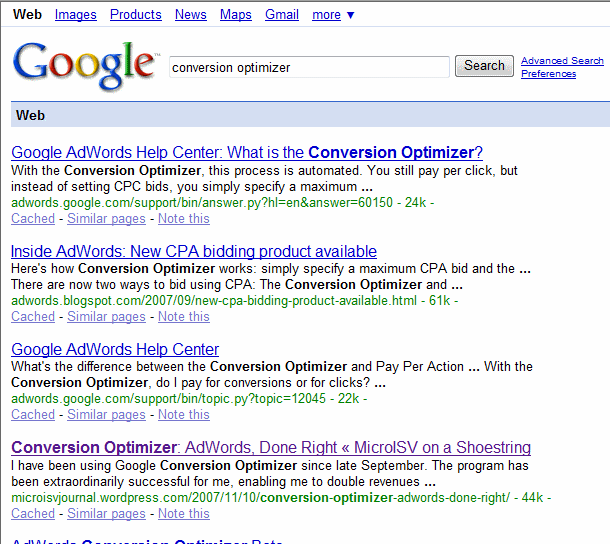
That is largely the result of a combination of a niche which was new, my early adoption of it, and radical transparency. There are, approximately, a billion Internet marketing and search engine watching blogs out there. Many of them are much, much higher profile than this blog. Many of these covered the launch of Conversion Optimizer, but I was (to my knowledge) the only person who backed up the first impressions with numbers, and as a result I attracted just a few more links than the next guy and, wham, the search engines think I’m the expert on the topic.
I mention this for two reasons: One, it is quite useful to know how to convince the search engines you are the expert on a particular topic. For niches which are brand spanking new (say, hmm, Blackberry spam filters after the introduction of the Blackberry), the combination of there being zero pre-existing links, less than a full Internet of competition, and massive first-mover’s advantage means that you can snag the top spots quite easily if you move reasonably quickly with something compelling. It’s not just enough to be there first, you have to be there “firstest with the mostest” — I think my first post on Conversion Optimizer was weeks after launch but the “real numbers” hook is extraordinarily more compelling than the “news you already read from Google’s blog” hook.
After you’re already on top, you’ll probably stay on top, because the guy on top becomes the canonical result to refer to the subject when anyone else just needs to introduce it. (This phenomenon is described in Filthy Linking Rich, probably the most worthwhile article from 2004 for a business owner in 2008.)
Aside from it being a useful business skill to learn how to position yourself as the expert on an emerging topic (and, for what it’s worth, I’m hardly the expert on this subject, just expert in the eyes of the computer algorithm that people trust to identify experts these days), this opened up a nice opportunity for my business. I hate to be coy, but it will be another week or so before I can say exactly what it was. For now, I just wanted to get this post timestamped so that I can refer to it for a before-after comparison in the wake of the announcement I expect to be making.
Someone on the BoS board asked a question today about how to execute linkbait well. I have an article on this blog about that, and wanted to paste a link, so I used my usual link repository — Google. I have a photographic memory for titles and can’t remember URLs to save my life, for some reason. Anyhow, the exact query was [developing linkbait for a non-technical audience], which as an exact match for the title Developing Linkbait for a Non-Technical Audience should be a cinch for Google.
I really wanted to post how Daily Bingo Cards was doing statswise today, but probably will not have the time. (The short version: the snowflake queries are loving me and owning a top 10 spot on every possible variation of “thanksgiving bingo cards” is worth 1.5X owning the 11th spot on [thanksgiving bingo cards] itself. Don’t ask me how you can rank for a phrase that competitive in less than 2 months of work.) While I know the analysis is the really interesting bit, for the stats geeks in the audience I decided to make my website stats public in real time. Enter a Rails plugin named Sitealizer, about five minutes of work, and powie, stats for anyone.